Building a hardware product is a journey that combines innovation, engineering, and business strategy. Unlike software, hardware requires physical components, manufacturing processes, and a complex supply chain, which makes the development process expensive and time-consuming. Many entrepreneurs underestimate the true cost, often leading to budget overruns, production delays, or even failure in the market. Understanding every stage of development—from conceptualization to launch—is essential for startups, small businesses, and inventors who want to avoid costly mistakes and successfully bring a product to market.
In this article, we will explore all the elements that contribute to the real cost of hardware product development, including design, prototyping, electronics, manufacturing, supply chain management, certification, marketing, and hidden expenses. By understanding these factors, businesses can plan budgets accurately, reduce risks, and optimize their resources.
1. Conceptualization and Market Research
The first step in building a hardware product is conceptualization, which involves turning a simple idea into a clear vision. This stage focuses on identifying a real problem, understanding the target audience, and evaluating the feasibility of the solution. Without careful research and validation, even the most technically sound products can fail to gain market traction.
Key Steps in Conceptualization and Market Research:
- Identify the target audience: Knowing who your product is for helps determine features, pricing, and marketing strategies. For instance, a fitness wearable designed for professional athletes will differ in design and functionality compared to one for casual users.
- Problem analysis: Clearly define the problem your product solves. Hardware products that address real pain points have a higher chance of success.
- Competitor research: Study existing products to understand their strengths, weaknesses, and pricing. This analysis helps you position your product strategically in the market.
- Feasibility study: Assess if the concept is manufacturable with current technology, materials, and budget constraints. This prevents unrealistic expectations and costly design changes later.
- Market validation: Conduct surveys, interviews, or focus groups to gather direct feedback from potential customers. This helps refine the product concept and ensures it meets user needs.

Investing in thorough concept validation is critical. Costs at this stage typically range from $2,000 to $15,000, depending on whether agencies, consultants, or in-house teams conduct the research. Although it may seem like a significant upfront expense, market research can prevent expensive mistakes during later stages.
2. Industrial and Mechanical Design
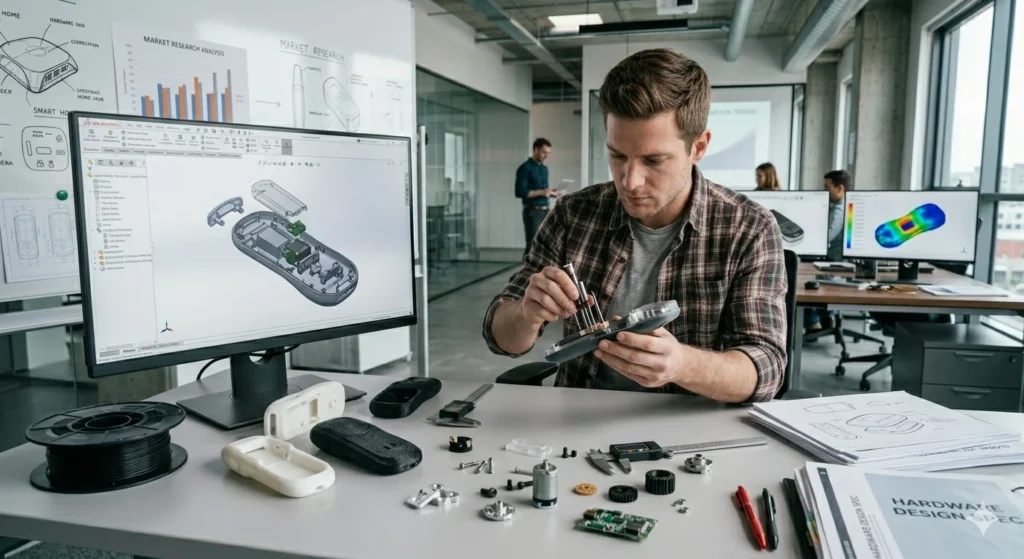
After validating the concept, the next stage is turning ideas into a tangible product through industrial and mechanical design. This phase balances aesthetics, usability, and manufacturability. Industrial design ensures the product looks appealing and aligns with the brand, while mechanical design ensures that the product is functional, durable, and manufacturable.
3. Electronics Design and Firmware Development
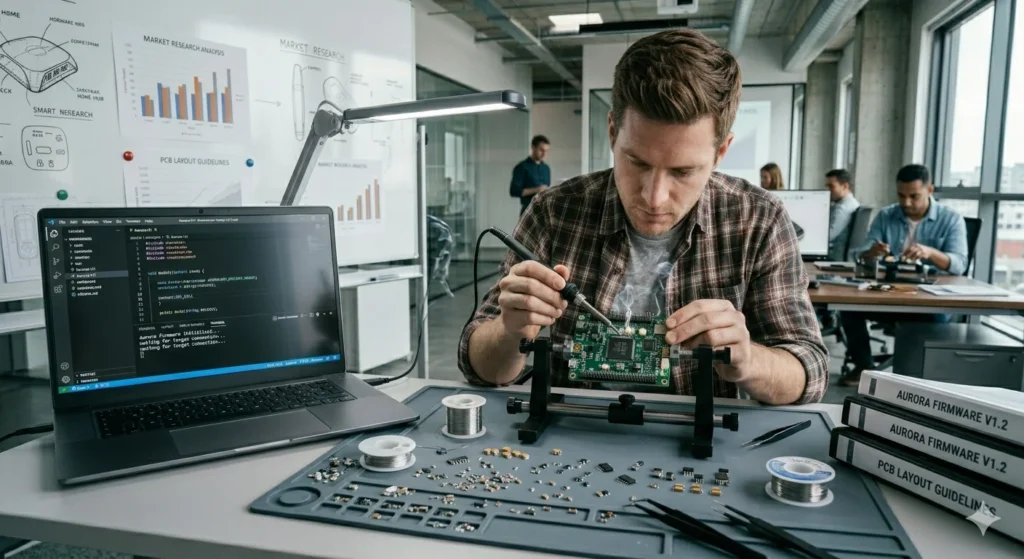
Modern hardware products heavily rely on electronics and firmware to function correctly. This stage involves creating schematics, PCB designs, and embedded software, which bring intelligence and connectivity to the device. Proper electronics design ensures reliability, performance, and user satisfaction.
Key Steps in Electronics and Firmware Development:
Key steps in developing electronics and firmware for a hardware product include:
- Schematic Design: Mapping connections between sensors, microcontrollers, power systems, and components to reduce errors during PCB manufacturing.
- PCB Design: Printed Circuit Boards must balance compact size, heat management, and manufacturability for long-term reliability.
- Component Selection: Choosing high-quality, cost-effective components minimizes the risk of failures and ensures availability through multiple suppliers.
- Firmware Programming: Embedded software controls sensors, actuators, and communication modules (Bluetooth, Wi-Fi, Zigbee) to ensure the device operates as intended.
- Iterative Testing: Testing electronics and firmware under real-world conditions identifies bugs, reliability issues, and ensures proper performance before production.
Neglecting careful electronics design can result in hardware malfunctions, software bugs, and costly product recalls. Development costs for electronics and firmware typically range from $10,000 to $100,000, depending on complexity and the number of prototypes.
4. Prototyping & Product Validation
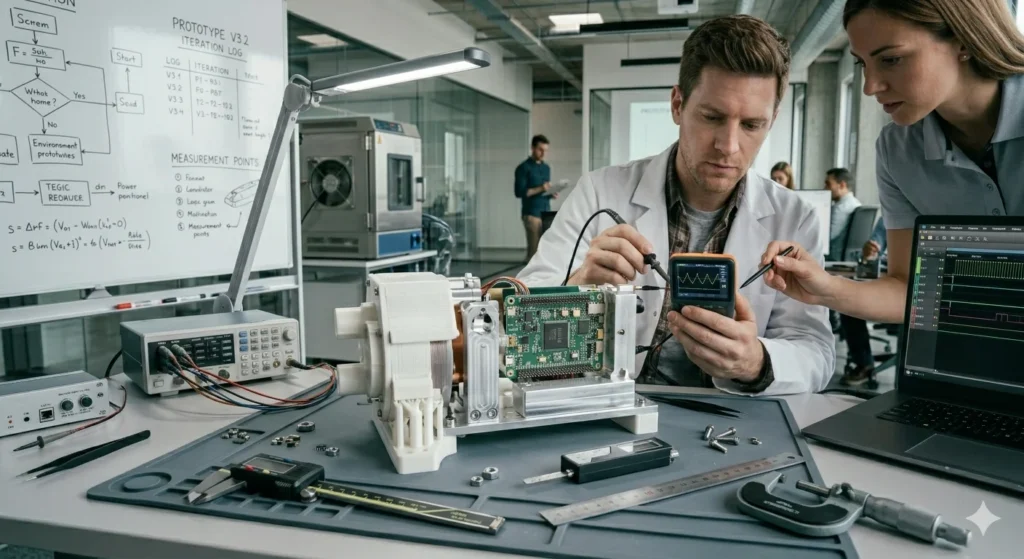
Prototyping is a critical phase in hardware development where digital concepts are transformed into tangible, physical models. This stage enables engineers and designers to validate the product’s design, functionality, and usability before moving toward full-scale manufacturing. Early-stage prototypes, often referred to as alpha versions, are primarily focused on testing core functionality, internal components, and basic form. These versions may not look polished but are essential for identifying technical feasibility. As development progresses, beta prototypes are created with improved design accuracy, refined aesthetics, and near-final functionality. These are used for more advanced testing, including durability, performance under real-world conditions, and compliance with regulatory standards.
With the advancement of modern technologies, rapid prototyping has significantly accelerated the product development cycle. Techniques such as 3D printing allow quick and cost-effective creation of complex shapes for ergonomic testing, while CNC machining provides high-strength, precise components suitable for functional testing. Additionally, laser cutting enables accurate fabrication of enclosures and structural parts. These technologies allow multiple iterations in a short time, helping teams refine designs efficiently. As a result, businesses can test different variations, improve product quality, and reduce time-to-market without committing to expensive tooling early in the process.
Key Benefits of Prototyping
Prototyping plays a vital role in minimizing risks and improving product reliability. By identifying flaws early, businesses can avoid costly redesigns and delays during the manufacturing phase.
The cost of prototyping typically ranges from $5,000 to $50,000, depending on product complexity, materials used, and the number of iterations required. While it may seem expensive initially, it ultimately saves significant costs by preventing large-scale production errors.
5. Manufacturing Costs
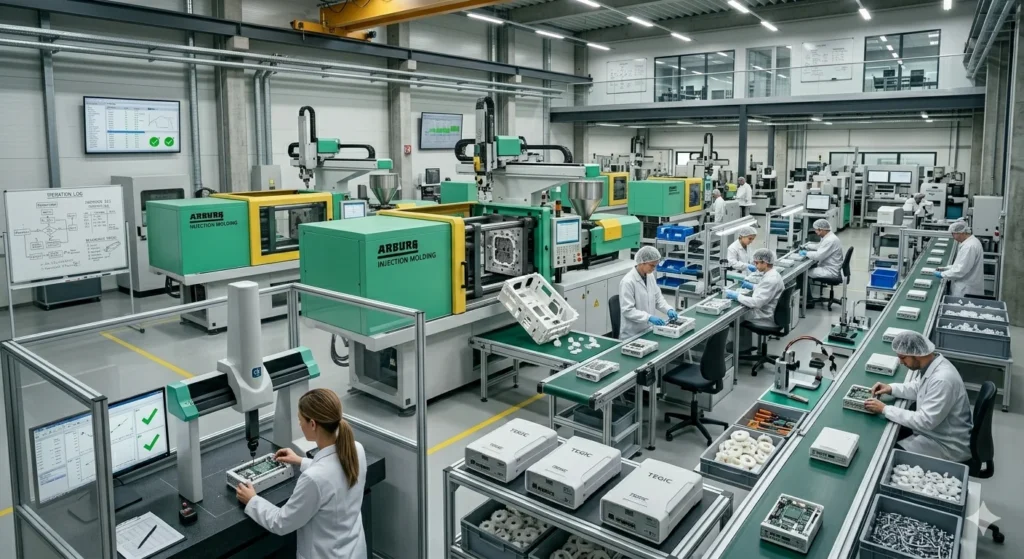
Manufacturing is often the most expensive stage in building a hardware product. Every step, from creating molds and setting up assembly lines to testing and packaging, affects the total cost. Choosing the right materials ensures durability but can increase expenses. Skilled workers are needed to assemble and check each unit properly. Other costs like factory management, equipment maintenance, and utilities also add up. Producing a small batch is more expensive per unit than mass production, so planning for larger volumes can save money. Efficient supply chains, reliable suppliers, and quality checks are essential to reduce delays, avoid waste, and make sure the final product is ready for the market.
| Key Components | Description & Cost Details |
|---|---|
| Tooling and Setup | Creating molds for injection-molded parts or jigs for assembly lines can cost $5,000 to $50,000 per component depending on complexity. |
| Materials | Costs include plastics, metals, electronics, and other components. Choosing high-quality materials improves durability but increases cost. |
| Labor and Assembly | Skilled technicians assemble, test, and package each unit. Labor costs vary by location and complexity of assembly. |
| Overhead | Utilities, factory management, quality control, and equipment maintenance all contribute to overall costs. |
| Economies of Scale | Producing a small batch may cost $50–$200 per unit, while mass production of 10,000+ units can reduce costs to $10–$50 per unit. |
Quality control is essential to maintain product standards and reduce the risk of warranty claims and returns, which can add 20–30% to total production costs. Proper planning and vendor selection are critical to keep manufacturing costs predictable.
6. Supply Chain and Logistics
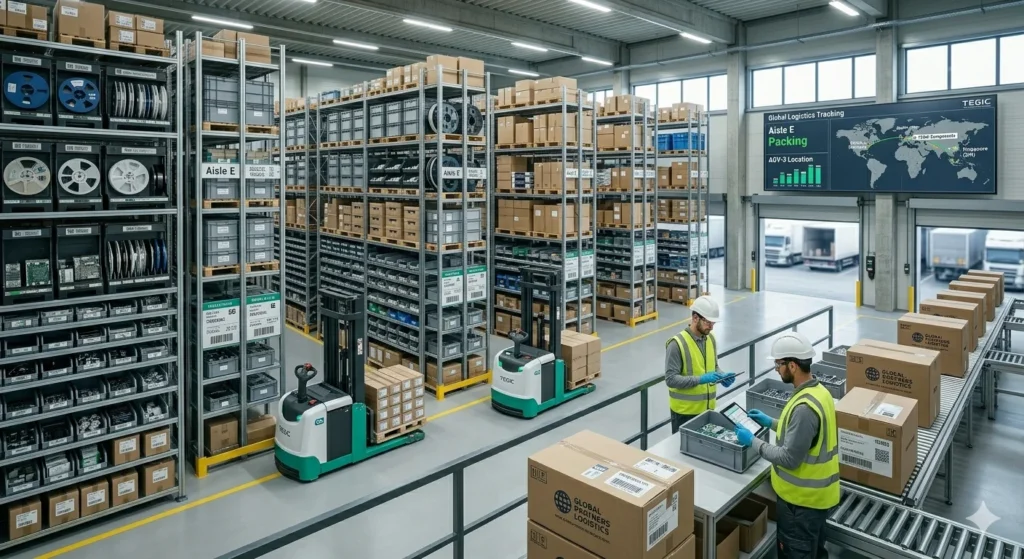
After production, the focus shifts to the supply chain and logistics. A strong supply chain ensures that components arrive on time, products are delivered efficiently, and costs are minimized.
Global sourcing is common in hardware development, but it introduces risks such as component shortages, shipping delays, and customs challenges. Shipping costs, import duties, and taxes must be accounted for, especially when manufacturing overseas.
Inventory management is another critical factor. Overproduction increases storage costs, while underproduction risks stockouts and lost sales. Unexpected disruptions, such as supplier bankruptcy or natural disasters, can also affect costs and timelines. Efficient supply chain planning can reduce unexpected expenses, which might otherwise increase total costs by 10–30%.
7. Certification and Compliance
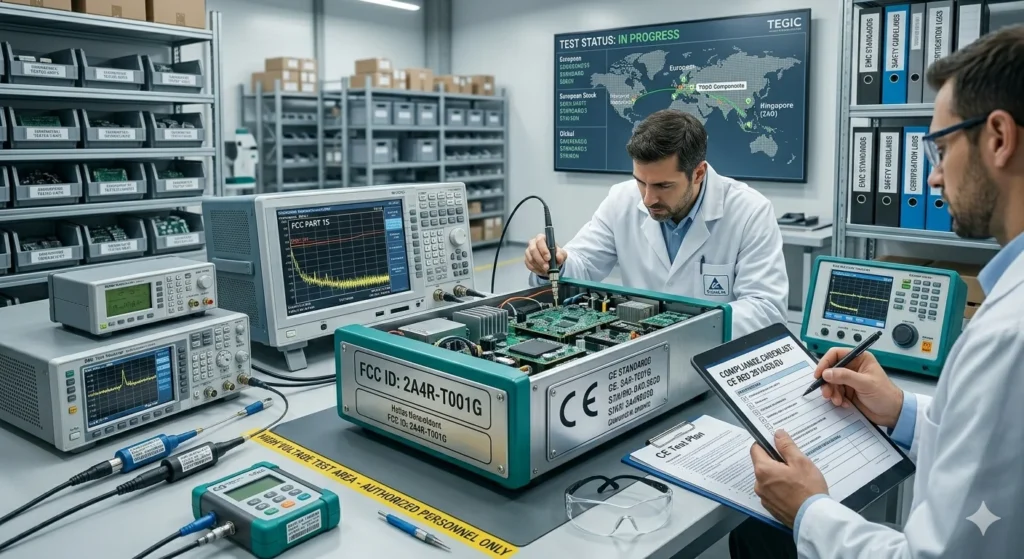
Hardware products must comply with regulatory standards to be legally sold in most markets. Certifications ensure the product is safe, reliable, and environmentally compliant.
Required for European markets to indicate conformity with safety standards.
Necessary for electronic devices in the US to comply with communication regulations.
Evaluates electrical safety for consumer devices to prevent hazards.
Ensures restriction of hazardous substances in electronics.
Manages electronic waste responsibly and promotes recycling.
Independent labs test products and documentation ensures compliance during audits.
Skipping certifications may save money initially but can lead to legal penalties, blocked sales, or product recalls, making it a non-negotiable expense. Certification costs typically range from $5,000 to $30,000 depending on the product and target markets.
8. Marketing and Launch Costs

Even if a hardware product is perfectly designed and manufactured, it won’t succeed without effective marketing. Marketing and launch strategies are critical to making your product visible, desirable, and accessible to potential customers.
Additionally, the distribution channels—whether selling directly to consumers online, through retail stores, or via distributors—affect costs through logistics, warehousing, and fulfillment. A carefully planned launch ensures that marketing resources are used efficiently to maximize reach and generate early sales momentum.
Typically, launch budgets can range from $10,000 to $100,000, depending on the scale of the campaign, the size of the target market, and the chosen marketing channels. Proper investment at this stage increases the likelihood of a successful product introduction and faster return on investment.
9. Hidden Costs and Contingencies

Even with meticulous planning, unexpected expenses are common in hardware product development. Hidden costs can significantly impact overall budgets and timelines.
Hidden Costs to Consider:
- Additional Prototypes and Redesigns: Iterative improvements can add costs unexpectedly.
- Component Obsolescence: Parts may become unavailable or replaced, requiring redesigns.
- Warranty Claims and Customer Support: Returns, repairs, and service support are ongoing expenses.
- Legal and IP Protection: Patents, trademarks, and potential infringement disputes may arise.
- Contingency Budget: Experts recommend reserving 20–50% of total budget for unforeseen expenses.
Accounting for hidden costs is essential for startups to avoid financial surprises and maintain product development momentum.
Conclusion
The real cost of building a hardware product goes far beyond the price of raw materials or manufacturing. From concept validation, industrial and mechanical design, electronics, prototyping, and manufacturing to supply chain management, certification, marketing, and hidden contingencies, each stage adds measurable costs.
A moderately complex hardware product typically requires a development budget of $50,000 to $500,000, excluding operational expenses. Proper planning, detailed market research, thorough prototyping, and effective supply chain management help businesses reduce risks, optimize resources, and successfully bring their products to market.
By understanding these costs and strategically managing each stage, hardware startups can develop high-quality products, achieve market success, and maximize return on investment.