Quick answer: a low cost PCB prototype in 2026 costs about $2 to $30 for five small 2 layer FR4 boards from a budget online fab, plus $15 to $40 for shipping. A US or EU quick turn shop charges about $50 to $250 for the same order. You save the most by keeping the board small and on 2 or 4 layers, using standard specs (1.6 mm FR4, 1 oz copper, HASL, green mask) and running a DFM check before you pay.
The headline price for a low cost PCB prototype tells you little about the final bill. Shipping, import duty, rush fees and a failed first spin can turn a $5 order into a $300 lesson. This guide shows you real price ranges, the costs most quote pages skip, and the design choices that keep your board cheap without making it fragile.
We write this as an independent PCB design and prototyping team, so you get numbers from several fabs side by side instead of one sales pitch.
Low Cost PCB Prototype Meaning: Cheap Price vs Good Value
A low cost PCB prototype is a small batch of test boards, made to prove a design before you pay for production. Teams order 5 to 10 pieces in most cases. “Low cost” should mean the lowest total spend to reach a working board. A $2 order that needs three respins costs you more than a $60 order that works the first time.
Keep two numbers in mind:
- Price per order: what the fab charges for the bare boards, shipping and fees.
- Cost per working design: the price per order multiplied by the number of spins you need, plus your engineering hours.
Our guide on why cheap hardware development ends up costing more covers the second number in detail. For prototypes, the lesson is short: spend your effort on getting the design right, and let the fab compete on price.
Bare Boards vs Assembled Low Cost PCB Prototypes
You can order low cost PCB prototypes in two forms, and the choice changes your budget:
- Bare boards: the fab makes the PCB and you solder the parts yourself. This is the cheapest route for simple boards with through hole or larger SMD parts.
- Assembled boards (PCBA): the fab also buys parts and solders them. Budget services advertise assembly from about $8 for 5 pieces, plus parts and a setup fee for each unique component.
For a low cost PCB prototype, hand soldering makes sense for a few boards with 0603 or larger parts. Once you have fine pitch QFNs, BGAs or more than 50 parts per board, paid assembly saves time and avoids damaged pads.
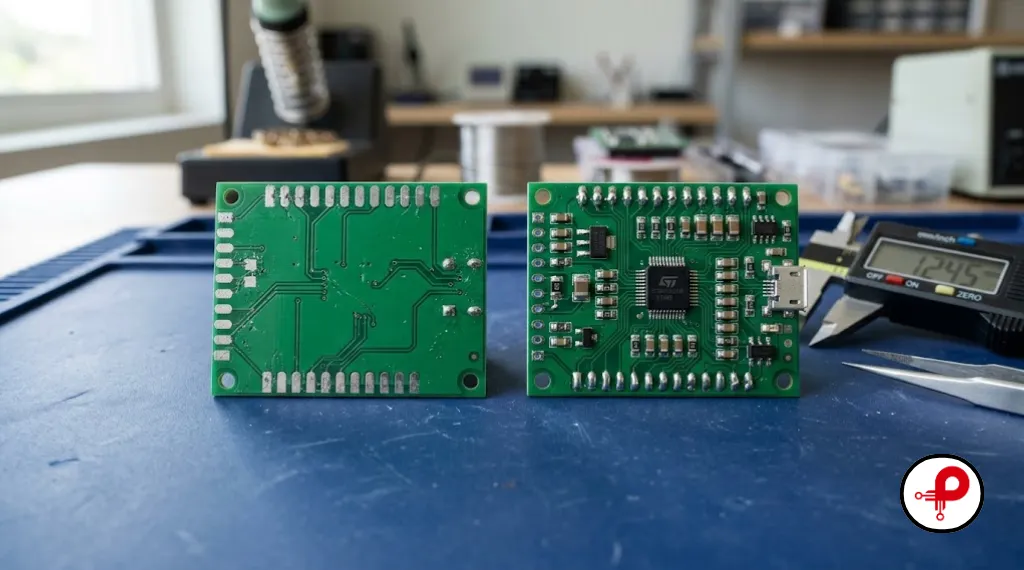
Low cost PCB prototype boards in green solder mask on an engineer’s bench
Low Cost PCB Prototype Prices in 2026
The table below collects public prices and vendor estimates we checked in October 2026. Treat them as starting points for a low cost PCB prototype budget. Your quote depends on size, specs and where you live.
| Board type (5 pcs, standard FR4, 1.6 mm) | Budget online fab (China) | US or EU quick turn shop |
|---|---|---|
| 2 layer, up to 100 x 100 mm | $2 to $30 | $50 to $150 |
| 4 layer, 50 x 50 mm | about $2 (promo) to $40 | $80 to $250 |
| 4 layer, 100 x 100 mm | $15 to $80 | $150 to $350 |
| 6 layer, 100 x 100 mm | $40 to $150 | $250 to $600 |
| Assembly add on (5 pcs) | from about $8 plus parts and setup | $300 and up |
| Shipping | $15 to $40 (express couriers) | often included or local |
Sources for these ranges: the LCSC and JLC price page lists “$2 for 5 pieces” for 1 to 2 layer boards up to 100 x 100 mm and $2 promotions for small 4 to 8 layer boards. PCBWay’s low cost prototype page shows real customer orders for 10 pieces of 2 layer boards at about $12 to $37 depending on size. AtlasPCB’s cost breakdown estimates $15 to $50 for 2 layer, $80 to $200 for 4 layer and $150 to $350 for 6 layer at 5 pieces with ENIG.
Why 5 Low Cost PCBs Cost Almost the Same as 10
Fixed costs make up 40 to 60 percent of a small order, according to AtlasPCB’s estimate. The fab pays for CAM review, film or direct imaging setup, drilling programs and electrical test fixtures once per order. AtlasPCB’s example puts 5 boards at about $80 and 10 boards at about $100.
On a low cost PCB prototype order, the extra 5 boards cost $20, or $4 each. Order 10 if you plan to test edge cases, give boards to a firmware developer or keep spares for rework. Order 5 if you expect the design to change after the first power up.
Low cost PCB prototype price table by layer count and quantity
Low Cost PCB Fabrication Pricing Explained
Low cost PCB fabrication works on panel sharing. Budget fabs merge orders from many customers onto one large production panel. Your board shares drilling, plating and etching time with dozens of others, so you pay a slice of the setup instead of all of it.
A low cost PCB prototype gets panel sharing prices when the board fits the shared panel’s settings. Step outside those settings and your order moves to a dedicated panel, and the price jumps. The PCB manufacturing process guide walks through each fab step if you want the full picture.
Cost Factors and Their Impact
| Factor | Cheap choice | Expensive choice | Typical impact |
|---|---|---|---|
| Layer count | 2 layers | 6 or more layers | Each step up about doubles the base price |
| Board area | Under 100 x 100 mm | Large or irregular outline | Price scales with panel area used |
| Material | Standard FR4, Tg 130 to 150 | High Tg, Rogers, polyimide | 2x to 10x material cost |
| Thickness | 1.6 mm | Under 0.6 mm or over 2.0 mm | Small surcharge to a dedicated panel |
| Copper weight | 1 oz outer layers | 2 oz or heavier | Longer plating and etching |
| Surface finish | HASL (leaded or lead free) | ENIG, ENEPIG, hard gold | ENIG adds about $8 to $15 per order |
| Solder mask | Green | Matte or special colours | Some fabs charge more and add days |
| Minimum trace and space | 6/6 mil (0.15 mm) | 3/3 mil or finer | Tighter process, lower yield |
| Minimum drill | 0.3 mm | Under 0.2 mm or laser vias | Microvias move you into HDI pricing |
| Lead time | Standard 3 to 7 days | 24 or 48 hours | Rush fees of 80 to 200 percent |
Two factors drive most of the price: layer count and board area. Fix those first. Our standard PCB thickness guide explains why 1.6 mm stays the cheapest default, and our PCB copper thickness article shows when 2 oz copper earns its cost.
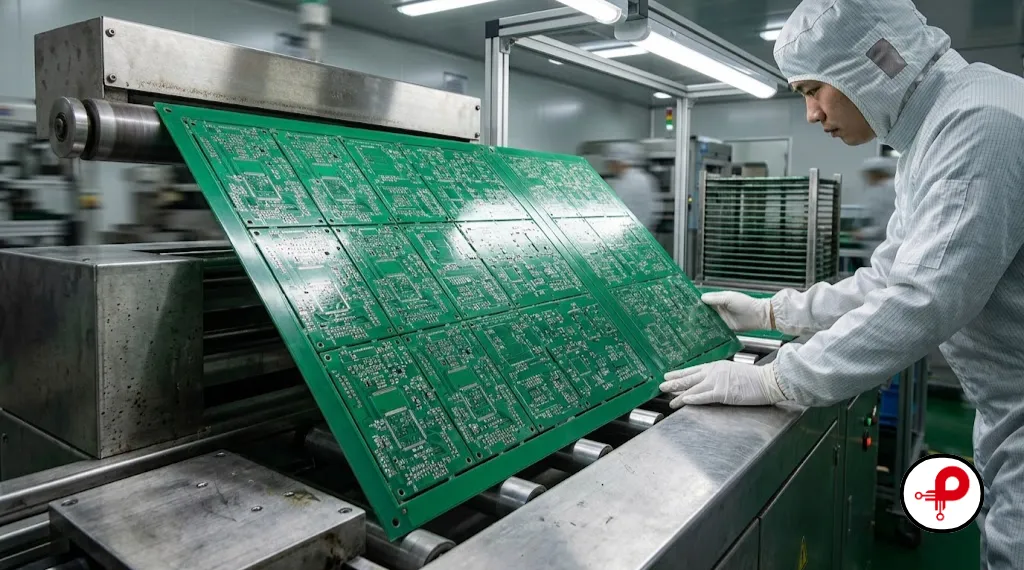
Low cost PCB prototype fabrication panel moving through a PCB factory
Hidden Costs Most Cheap PCB Quotes Leave Out
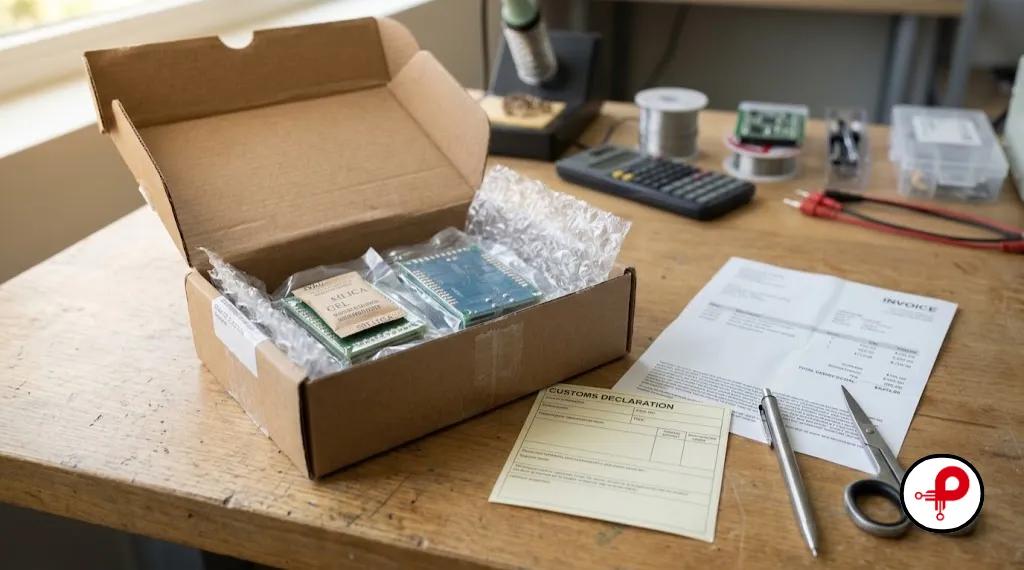
A $2 low cost PCB prototype price grabs attention, and the checkout page adds the rest. Plan for these items before you compare quotes.
Shipping and Import Duties
Express couriers such as DHL and FedEx often cost more than the boards. Expect $15 to $40 for a small parcel from China, with economy options cheaper and slower. Import duty, VAT or sales tax depends on your country and on current trade rules.
US buyers saw tariff changes in 2025 push the landed cost of Chinese boards up, and many hobbyists on forums started comparing EU and US fabs again. Check the duty line on your quote, or ask the courier for an estimate, before you order.
Setup, Tooling and Special Options
Most budget fabs hide setup in the base price. Watch for extra charges on:
- Castellated holes, edge plating and countersinks.
- Impedance control with test coupons.
- Blind or buried vias.
- Gold fingers with bevelling.
- Panelization with V scoring or mouse bites added by the fab.
Testing and the Cost of a Respin
Many budget fabs run a flying probe or E test on 2 layer boards for free. Confirm it for 4 layer and above. Testing catches opens and shorts in the board, though it cannot catch your design mistakes.
The biggest hidden cost of a low cost PCB prototype is a respin. A wrong footprint or a swapped pin costs you a new order, new shipping and one to three weeks. Our list of common PCB design mistakes covers the errors we see most in first prototypes.
Low cost PCB prototype shipping box, customs paperwork and invoice
9 Proven Ways to Get a Low Cost PCB Prototype

Use this checklist before you upload Gerber files. Each step either lowers the quote or lowers your chance of a respin.
1. Keep the Board Under 100 x 100 mm
Budget fabs price their best deals on boards up to 100 x 100 mm. If your design sits at 105 mm, try to pull it in. Move connectors to the edge, rotate parts and shrink keep out areas you don’t need.
2. Use the Fewest Layers That Work
Route on 2 layers when signal speed and density allow. Move to 4 layers when you need a solid ground plane for USB, Ethernet, RF or fast switching regulators. A clean 4 layer board that works first time beats a crowded 2 layer board that picks up noise.
3. Stick to Standard Specs
Choose FR4, 1.6 mm thickness, 1 oz copper, HASL finish and green solder mask unless the design needs something else. Pick ENIG for fine pitch BGAs and QFNs, since flat pads improve the yield. Our PCB surface finish types guide compares the options and costs.
4. Design to the Fab’s Capability Table
Read the fab’s capability page before you set design rules. Use 6/6 mil trace and space and 0.3 mm drills where you can. Our page on standard PCB drill sizes lists common hole sizes, and the circuit board design rules article covers clearances.
5. Run a DFM Check Before You Pay
Many fabs run a free DFM review after upload. Run your own DRC first, then open the Gerbers in a viewer and check each layer. Our DFM and DFA guidelines give you a fuller checklist.
6. Pick Standard Lead Time
Rush fees of 80 to 200 percent add little value on a first low cost PCB prototype. Order a week ahead and use the waiting time to write firmware or prepare your test plan.
7. Panelize Small Boards Yourself
If you need several small boards, place them on one panel with V scores or tab routing. Some fabs charge extra for multiple designs on one panel, so check the rules before you try this.
8. Choose Stock Parts for Low Cost PCB Prototype Assembly
Choose parts from the assembler’s in stock library to skip extended part fees. Use common passives in 0603 or 0402 sizes. Keep a second source for each critical part so a stock shortage doesn’t stop your build.
9. Use Free PCB Design Software
Free tools cut the cost of a low cost PCB prototype before you place an order. KiCad is open source, has no board size limits and exports clean Gerber RS 274X and Excellon drill files. EasyEDA runs in a browser and links to a fab and parts library. Both work well for low cost PCB design software needs.
Our longer guide on how to reduce prototype cost without losing quality applies these ideas to the whole product, beyond the PCB.
Low cost PCB prototype design checked in KiCad before ordering
Choosing a Low Cost PCB Manufacturer: China, USA or Local
Your choice of fab shapes the price, the lead time and the risk. Here is how the main options compare for a low cost PCB prototype.
OSH Park lists its standard 2 layer service at $5 per square inch for three copies, with orders shipping in 9 to 12 days, on its 2 layer service page. A 25 x 25 mm board (about 1 square inch) costs about $5 for three, which beats most overseas orders once you add courier fees.
Low Cost PCB USA Options
US buyers who want low cost PCB USA options should compare shared panel services first. Domestic quick turn shops charge more per board, though you skip import duty and customs delays. For regulated products, defence work or designs you must keep inside the country, a US fab is the safe choice.
Quality Checks Before You Trust a Cheap Fab
Ask any new fab these questions before your first low cost PCB prototype order:
- Do you work to IPC Class 2 by default, and do you E test all boards?
- Can you share your capability table and a sample of a recent board?
Red flags include no published capability data, no DFM feedback, prices far below the market and no clear contact details. Our PCB testing and inspection guide explains what a good fab checks and which IPC class fits your product.
Low cost PCB prototype boards from overseas and local manufacturers
Ordering vs DIY: PCB Milling, Etching and PCB Printers

Making a low cost PCB prototype at home looks cheap, and for some projects it is. Compare the full cost before you buy a machine.
Chemical Etching and Toner Transfer
Toner transfer with ferric chloride or sodium persulfate costs a few dollars per board in materials. You get single sided or simple double sided boards with traces down to about 0.3 mm on a good day. You also handle etchant waste, which needs safe disposal under local rules.
Desktop PCB Milling
A desktop CNC mill isolates traces by cutting copper away. Entry machines cost a few hundred dollars, and professional units such as LPKF systems cost many thousands. Milling suits single and double sided boards with through holes, with no plated vias unless you add rivets or a plating kit.
PCB Printers
Conductive ink printers such as Voltera print traces and dispense solder paste on a desk. They fit labs that iterate small boards each day. The machine price and ink costs pay back after you build many boards over months or years.
Ordering vs Making at a Glance
| Method | Cost per board | Plated vias | Fine pitch parts | Turnaround |
|---|---|---|---|---|
| Budget online fab | $1 to $10 plus shipping | Yes | Yes | 5 to 12 days |
| Toner transfer etching | $2 to $5 | No | Hard | Same day |
| Desktop CNC milling | $3 to $10 plus machine cost | With extra kit | Limited | Same day |
| Conductive ink printer | Ink plus machine cost | Limited | Limited | Same day |
For most teams, ordering online gives you the cheapest working low cost PCB prototype. DIY methods win when you need a simple board the same day or when you test layouts many times a week.
Low cost PCB prototype made on a desktop PCB milling machine
Worked Example: One Board, Three Prices
Take a 4 layer sensor board at 80 x 60 mm, ordered as a 10 piece low cost PCB prototype. AtlasPCB uses this case in its own cost breakdown, and the pattern matches what we see in client quotes.
| Version | Specs Chosen | Estimated Price |
|---|---|---|
| Over specified | ENIG, 2 oz copper, black matte mask, 0.2 mm drills, 48 hour turn | about $380 |
| Standard | ENIG, 1 oz copper, green mask, 0.3 mm drills, standard turn | about $120 |
| Optimized | HASL lead free, 1 oz copper, green mask, board trimmed to fit standard panel, standard turn | about $95 |
The optimized version costs a quarter of the over specified one. The board does the same job. The engineer removed specs the circuit did not need and accepted a few more days of waiting.
A few lessons carry over to your own design:
- Ask “does the circuit need this?” for each non standard option.
- Keep ENIG when you have fine pitch parts, and drop it when you don’t.
If you need help balancing cost and reliability, our team offers PCB design services for startups, and our guide to choosing a prototype development company explains what to ask any partner. You can also read about the real cost of building a hardware product to see where the PCB sits in your full budget.
Low cost PCB prototype worked example with three versions of one board
FAQ About Low Cost PCB Prototype
1. What is the cheapest PCB manufacturer?
↑2. Who are some low cost PCB manufacturers?
↓3. How much does 1 PCB cost?
↓4. How much does it cost to create a PCB?
↓5. How much does it cost to design a PCB?
↓6. How much does an average PCB cost?
↓Conclusion
A low cost PCB prototype comes from good design choices first and a cheap fab second. Keep the board small, use 2 or 4 layers, choose standard specs and run a DFM check before you pay. Then compare the full landed cost, including shipping, duty and assembly, across a budget overseas fab and a local option.
Spend money where the circuit needs it, such as ENIG for fine pitch parts or a 4 layer stackup for clean ground, and cut the rest. That approach gets you working boards at the lowest total cost per design, which matters more than the price on the first page of a quote.
Want a second pair of eyes on your layout before you order your next low cost PCB prototype? Our PCB design services for startups team can review your files and cut cost from your next spin.