Quick answer: prototype cost for startups runs from about $500 to $5,000 for a bootstrapped proof of concept, $5,000 to $25,000 for a pre seed works like and looks like prototype, and $25,000 to $150,000 or more for seed stage integrated builds that are close to production. Your stage, your product’s complexity and the number of design spins decide where you land. Plan for at least two hardware revisions and keep a 15 to 25 percent contingency.
Founders tend to budget for the parts and forget the engineering. A connected device with a custom PCB, firmware and an enclosure needs design time, test time and a second build after the first one shows its flaws. This guide lays out prototype cost for startups stage by stage, shows what investors expect at each step, and covers the ways you can pay for the work without burning your runway.
If you want the general price ranges by prototype type first, read our guide on how much prototypes cost. This article focuses on the decisions a startup founder makes with limited cash.
Prototype Cost for Startups: Quick Budget Table by Stage
Hardware teams move through a series of builds. Each build answers a different question, and each one costs more than the last because it carries more engineering.
| Build stage | Indicative startup budget | What it proves |
|---|---|---|
| Proof of concept | $500 to $5,000 | The core idea works at all |
| Works like prototype | $3,000 to $20,000 | The electronics and firmware do the job |
| Looks like prototype | $1,000 to $10,000 | Size, shape and user experience |
| Integrated alpha (works like and looks like) | $10,000 to $50,000 | One unit that does both |
| EVT build (engineering validation) | $25,000 to $100,000+ | The design meets its specs across several units |
| DVT build (design validation) | $50,000 to $250,000+ | The design passes reliability and pre compliance tests |
These are indicative planning ranges for a small connected hardware product, not supplier quotes. A simple mechanical product sits at the low end. A battery powered wireless device with a custom PCB, an app and certification needs sits at the high end.
The table also shows why prototype cost for startups climbs fast after the first build. A proof of concept can run on a development board and a breadboard. An EVT build needs a custom PCB, test fixtures, a stable firmware release and several identical units.
For a line by line budget for one build, our guide to the cost of prototyping a product breaks each expense down.
Why Hardware Startups Spend More Than They Plan
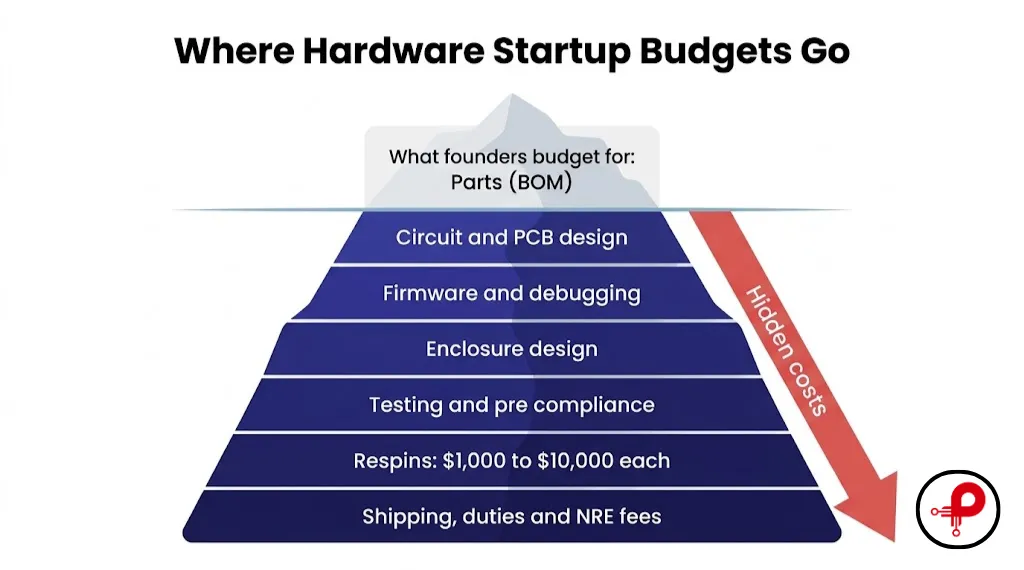
Most overruns in prototype cost for startups come from two sources: underestimated engineering time and extra design spins. Parts make up a small share of the total.
Engineering time outweighs parts
A first time founder often prices the bill of materials (BOM) and stops there. A $40 BOM can sit inside a $15,000 prototype because circuit design, PCB layout, firmware, enclosure design and testing all take paid hours. Our worked example in how much prototypes cost shows components at about 8 percent of a $3,650 electronics prototype budget.
Each respin costs money and weeks
A wrong footprint, a noisy power rail or a connector that blocks the enclosure lid forces a new PCB order, new parts and new assembly. One respin can add $1,000 to $10,000 and two to six weeks, depending on board complexity and assembly. Our article on why cheap hardware development ends up costing more shows how skipped reviews turn into extra spins.
Hidden costs startups miss
Watch for these items in your plan:
- Non recurring engineering (NRE) fees for design work and test fixtures.
- Shipping, import duty and rush fees on PCB and parts orders.
- Pre compliance testing for EMC and safety before formal certification.
- Your own time, which has a real cost even when you don’t pay yourself.
Prototype cost for startups looks smaller on paper than in practice for these reasons. A realistic plan budgets for the second and third build from the start.
Prototype Cost for Startups by Funding Stage
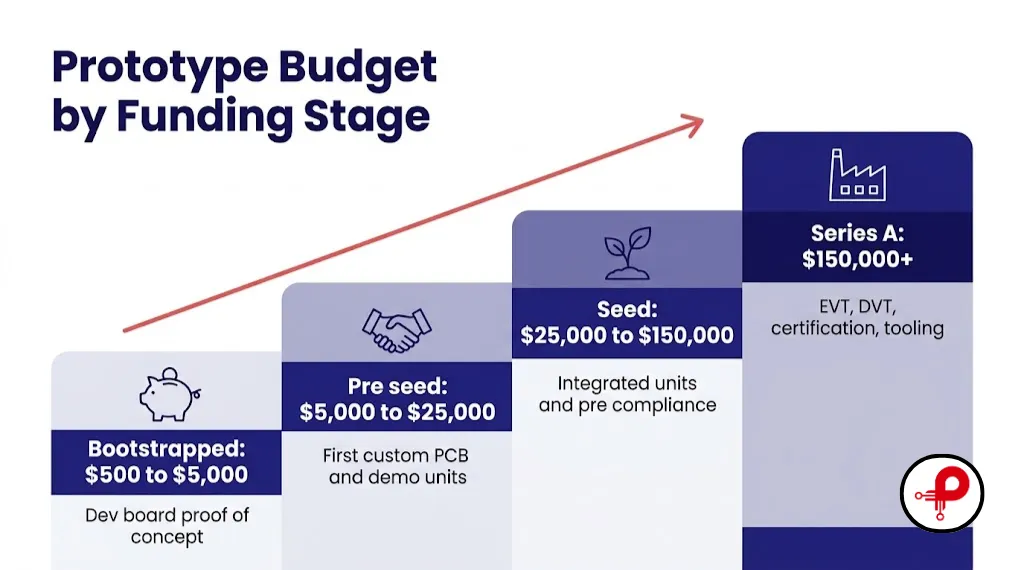
Your funding stage sets how much you can spend and what the prototype has to prove, so it shapes prototype cost for startups more than any other factor. A bootstrapped founder needs evidence the idea works. A seed stage team needs units that look and behave like a product.
Bootstrapped and pre revenue: $500 to $5,000
At this stage you prove the core function with the cheapest tools that answer the question. Use development boards such as an ESP32 or Arduino, off the shelf sensors, a breadboard and a few 3D printed parts. Our IoT prototyping guide walks through this kind of early connected build.
Spend on the riskiest part of the idea first. If the product depends on a sensor reading a signal through plastic, test that before you design an enclosure or an app.
Pre seed: $5,000 to $25,000
Pre seed money pays for the first custom PCB, working firmware and a looks like model you can put in front of investors and early customers. Many teams build a works like prototype and a looks like prototype as two separate units at this stage, since merging them costs more.
Board costs stay modest if you keep the design simple. Our guide to a low cost PCB prototype shows that five small 2 layer boards can cost under $30 before shipping. The engineering around those boards is where the pre seed budget goes.
Seed: $25,000 to $150,000
Seed stage prototype cost for startups covers an integrated design that works and looks like the product, several identical units for user trials, and early design for manufacturing (DFM) review. You may also run pre compliance tests for EMC and safety so certification doesn’t surprise you later.
At this point many founders hire a partner. Our guide to choosing a prototype development company lists what to ask before you sign.
Series A and beyond: $150,000 and up
After Series A, the work shifts from prototypes to production readiness: EVT, DVT and PVT builds, formal certification, tooling and contract manufacturer setup. These costs belong to product development more than prototyping, and the total for a connected device can reach several hundred thousand dollars.
| Funding stage | Main goal | Typical build | Indicative budget |
|---|---|---|---|
| Bootstrapped | Prove the idea | Dev board proof of concept | $500 to $5,000 |
| Pre seed | Show investors and early users | First custom PCB, works like and looks like units | $5,000 to $25,000 |
| Seed | Prove the product | Integrated units, DFM review, pre compliance | $25,000 to $150,000 |
| Series A | Prepare for production | EVT, DVT, certification, tooling | $150,000+ |
Example: a pre seed smart sensor startup
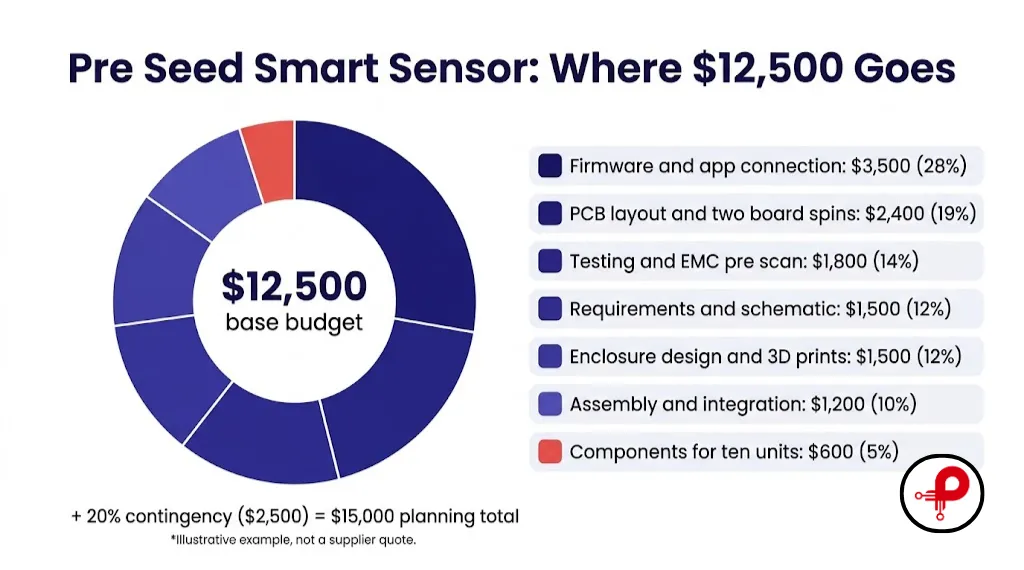
Picture a two founder startup building a battery powered sensor that sends readings to a phone app. They have pre seed money and need ten working units for investor demos and a small user trial. Here is how their prototype cost for startups budget could look. These figures are illustrative allowances, not a quote.
| Line item | Allowance |
|---|---|
| Requirements, block diagram and schematic | $1,500 |
| PCB layout, two board spins with fabrication and assembly | $2,400 |
| Components for ten units | $600 |
| Firmware and app connection | $3,500 |
| Enclosure design and 3D printed shells | $1,500 |
| Assembly and integration | $1,200 |
| Testing, debugging and an EMC pre scan | $1,800 |
| Base budget | $12,500 |
| Contingency (20%) | $2,500 |
| Planning total | $15,000 |
Parts for ten units cost $600, under 5 percent of the plan. Firmware, the second board spin and testing take the largest shares. A founder who budgets only for parts would plan for a fraction of the real prototype cost for startups at this stage.
The same team could cut the total by reusing a proven reference design for the radio, holding the app to one screen for the demo, and testing two units before assembling all ten.
What a Startup Prototype Budget Should Include
A clear prototype cost for startups budget splits the work into line items so you can compare quotes and cut the right things. Use this list as a checklist for any startup product development cost estimate.
| Budget item | What it covers | Share of a typical electronics prototype |
|---|---|---|
| Requirements and design | Specs, block diagram, CAD, schematic | 10 to 15% |
| PCB design and fabrication | Layout, boards, stencils | 15 to 20% |
| Firmware | Embedded code, drivers, connectivity | 20 to 30% |
| Components | BOM parts for each unit | 5 to 15% |
| Enclosure | Design and 3D printed or machined parts | 8 to 12% |
| Assembly and integration | Soldering, wiring, fit checks | 8 to 12% |
| Testing | Functional tests, debugging, pre compliance | 10 to 15% |
| Contingency | Respins and surprises | 15 to 25% on top |
The shares are a planning guide based on the worked example in our how much prototypes cost article. Your mix will shift with the product. An app connected device carries more firmware and software cost. A product with moving parts carries more mechanical cost.
Don’t forget intellectual property
Patents sit outside the prototype budget, though many founders pay for them in the same months. The USPTO raised its standard filing, search and examination fees for a utility application from $1,820 to $2,000 for large entities in 2025, with reduced fees for small and micro entities, according to a summary of the 2025 USPTO fee schedule. Attorney fees come on top of government fees.
Our real cost of building a hardware product guide covers the costs beyond the prototype, from certification to inventory.
MVP vs Prototype: What Investors Expect to See
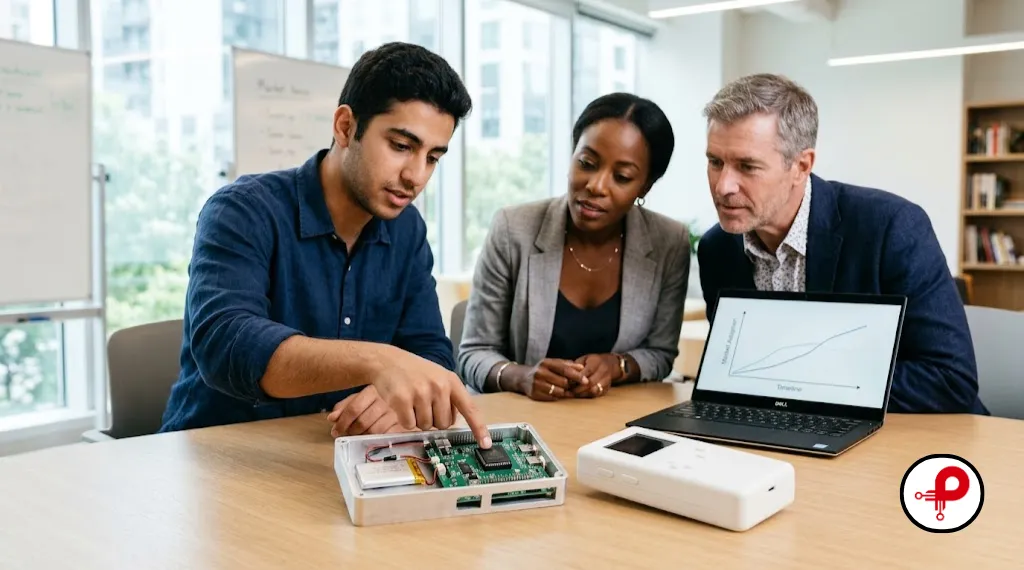
Founders mix up the two terms, and the mix up changes the budget. A prototype tests a question. A minimum viable product (MVP) is the smallest version a real customer can use and pay for.
Prototype
A prototype can be rough. It can sit on a breadboard, use a 3D printed shell and need a laptop to run. Its job is to prove that the core function works.
MVP
A hardware MVP has to survive real use. That means a custom PCB, stable firmware, an enclosure a customer can hold, and enough units for a small pilot. MVP prototype cost for a connected device lands in the seed stage range in our table, because it includes integration, testing and a small batch.
What investors look for
Investors at pre seed want proof that the core technology works and that you understand the path to production. A works like prototype and a looks like model, shown side by side, often do that job for less money than one integrated unit.
Bring numbers with the demo. A one page budget that shows your prototype cost for startups to date, the cost of the next build and the expected unit cost at volume tells an investor you understand hardware economics. Keep the demo short and reliable. A prototype that works on the third try in front of investors hurts more than a simpler one that works on the first.
Crowdfunding platforms set their own bar. Kickstarter requires hardware and product design creators to show a working prototype, and it won’t accept photorealistic renderings in place of one, according to its rules for hardware and product design projects. Plan your prototype cost for startups around the proof your next funding source asks for.
How Startups Pay for a Prototype
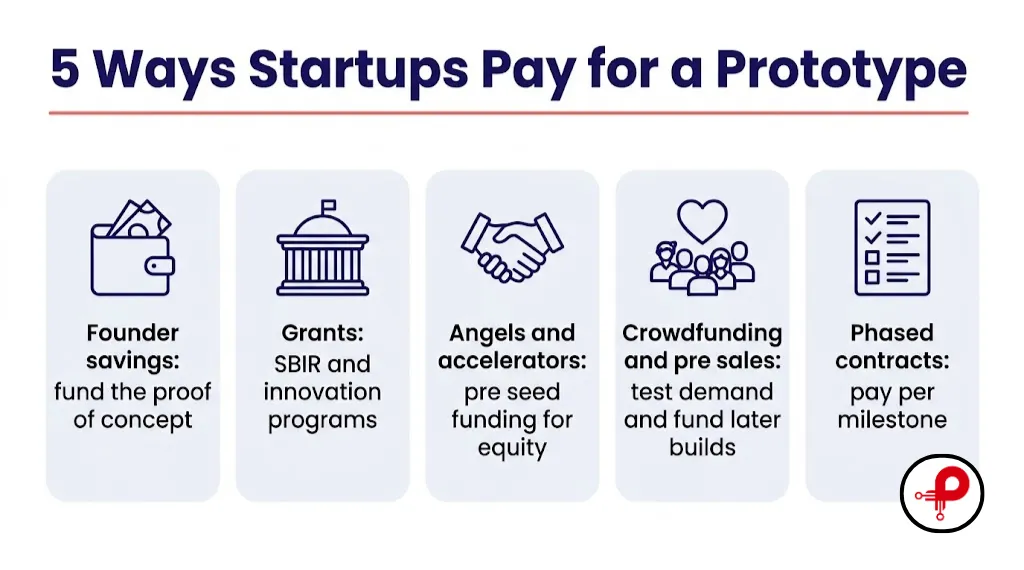
Funding the first build is a common problem for hardware founders, and the way you pay shapes your prototype cost for startups as much as the design does. You have several ways to pay, and many teams combine two of them.
Bootstrapping and founder savings
Most proof of concept builds are paid from savings. Keep this stage small and focused so your own money buys the evidence you need to raise more.
Grants and government programs
Grants suit founders who can wait a few months for a decision.
Government innovation grants can fund research and prototype work without giving up equity. In the US, the SBIR program funds small businesses doing research and development. Phase I awards fund feasibility work, with a total ceiling of $295,924 reported for 2022/23 on the NIDA SBIR budget page. Caps change, so check the current figure with the agency you apply to. Outside the US, check your national innovation agency for similar programs.
Accelerators and angel investors
Hardware accelerators and angel investors often fund the pre seed build in exchange for equity. Bring a working proof of concept and a clear budget for the next build.
Crowdfunding and pre sales
Crowdfunding and pre sales can fund the final prototype and first production run, and they test demand at the same time. You will need a working prototype first, so this route suits a later stage.
Phased payment with a development partner
Many product development firms split projects into phases with fixed deliverables. You pay for the proof of concept, review it, then decide on the next phase. That keeps prototype cost for startups tied to results. Our PCB design services for startups work this way.
8 Ways to Lower Prototype Cost for Startups
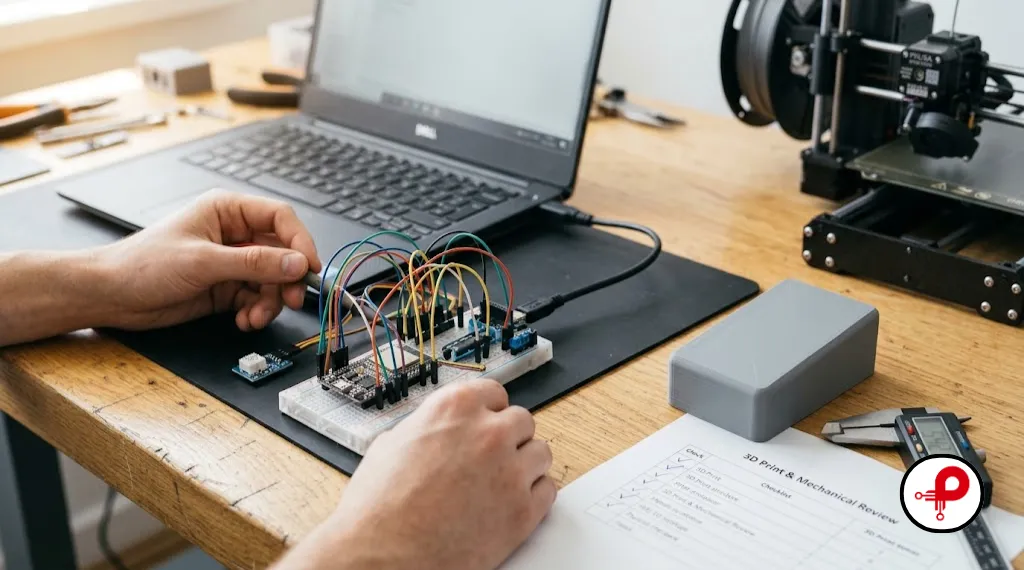
Lowering prototype cost for startups means skipping work you don’t need yet while keeping the tests that matter.
1. Prototype the riskiest part first
Find the one function your product cannot live without and test it alone. A $50 dev board test can kill a bad idea before you spend $10,000 on a custom PCB.
2. Use development boards before a custom PCB
An ESP32 or Arduino board lets you test sensors, logic and connectivity in days. Move to a custom board once the circuit is proven.
3. Split works like and looks like builds
Two cheap, focused prototypes often cost less than one integrated unit at the early stage. Merge them once both designs are stable.
4. Keep the PCB simple
Stay on 2 or 4 layers, use standard specs and keep the board small. Run a DFM check before you order. Our DFM and DFA guidelines show the rules that prevent respins.
5. Design the enclosure around standard parts
Use standard screws, inserts and connectors, and leave room for wiring and test access. Our electronic enclosure design guidelines cover wall thickness, bosses and fit.
6. Test before you scale the build
Debug one or two units from end to end before you build ten. A design flaw copied across ten boards costs ten times as much to fix. Our guide to PCB testing and inspection covers the board level checks.
7. Freeze the feature list per build
Each extra feature adds design, firmware and test hours. Write down what this build must prove and hold the line.
8. Get itemised quotes
Ask suppliers to split the price into design, fabrication, assembly, firmware and testing. Itemised quotes let you compare like for like and cut the right line.
Prototype vs Mass Production Cost: Planning the Next Step
Prototype costs and production costs follow different rules. A prototype pays high costs per unit to buy speed and flexibility. Production pays high upfront costs to buy low unit prices.
| Cost item | Prototype | Mass production |
|---|---|---|
| Enclosure | 3D printing or CNC, no tooling | Injection moulding tooling, low cost per part |
| PCB assembly | Small batch, high setup share per board | Panelised runs, low cost per board |
| Unit cost | High | Low |
| Upfront cost | Low to moderate | High (tooling, fixtures, certification) |
| Changes | Cheap and fast | Expensive once tooling is cut |
The jump from prototype to production is where many hardware startups run short of money. Production tooling for plastic parts can run from $10,000 to $100,000 or more. Prototype tooling, such as the aluminium tools described on Protolabs’ prototype tooling page, can bridge the gap for small runs.
Plan this step early, because the gap between prototype cost for startups and production cost catches many founders out. Choose materials, tolerances and assembly methods your contract manufacturer can handle, and run a DFM review before you freeze the design. If you need help with the full path, you can request a quote from our team.
FAQ About Prototype Cost for Startups
1. How much does a prototype cost?
↑2. What is the typical cost of creating a prototype?
↓3. How much does it cost to create a startup?
↓4. What is one way to pay for a prototype?
↓5. How much does it cost to make an invention?
↓6. What is the average cost to patent an idea?
↓Conclusion
Prototype cost for startups depends on your stage more than any single price list. Bootstrapped founders can prove an idea for under $5,000 with dev boards and 3D prints. Pre seed teams spend $5,000 to $25,000 on the first custom PCB and investor demo units. Seed stage teams move into integrated builds and pre compliance work that can pass $100,000.
Budget for the engineering, not only the parts, and plan for at least one respin. Match each build to the proof your next funding source needs, and use grants, phased contracts or pre sales to spread the cost. If you want a realistic plan for your own product, our team offers PCB design services for startups and can scope your next build.