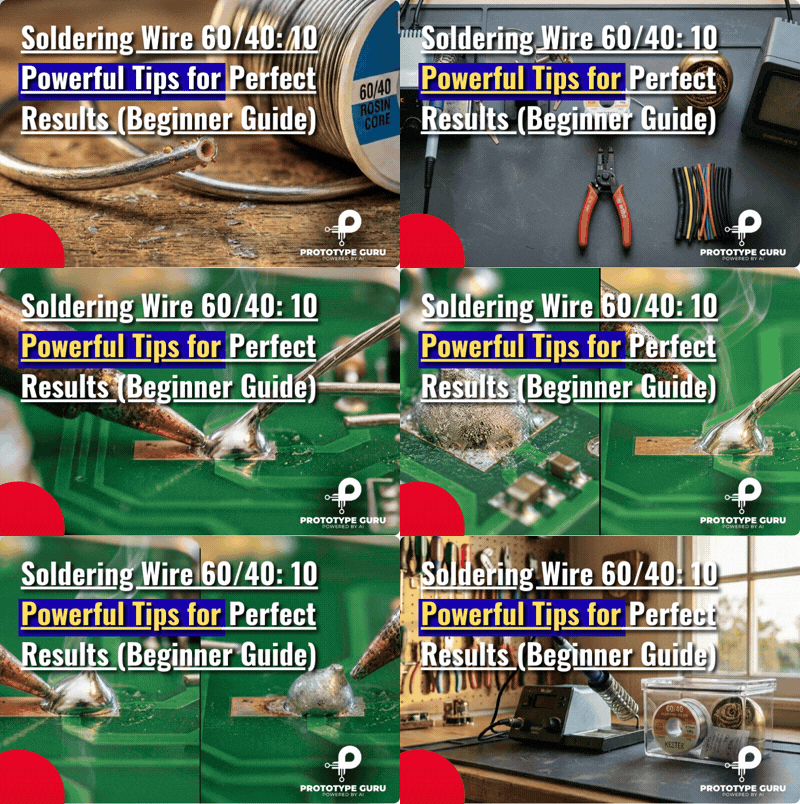






Selecting the appropriate solder wire is the most crucial decision for anyone starting their journey into electronics or DIY repairs. Among the various solder alloys available, the 60/40 tin-lead solder wire remains the standard choice for both hobbyists and professionals due to its reliable melting point and excellent flow characteristics. The ease of creating a connection significantly impacts the longevity of your device when using a soldering iron. Understanding how this specific alloy reacts to heat can save you hours of frustration and help avoid damaging components in your early projects.
Many newcomers encounter difficulties with “cold joints” or irregular connections because they do not fully understand the fundamentals of solder wire. This guide aims to narrow the gap between having the necessary tools and mastering the craft. We will discuss why the 60/40 mixture is preferred over lead-free alternatives for those new to soldering, how the internal flux core functions to clean your workspace, and the exact process required to consistently produce a shiny, volcano-shaped joint. By focusing on these crucial methods, you will advance from a novice to a proficient maker, capable of handling complex circuit boards and cable repairs with confidence and skill.
Comprehending the Fundamentals of 60/40 Rosin Core Solder
The designation 60/40 pertains to the proportion of tin and lead found within the solder wire, which is a known tin-lead alloy. This particular ratio is valued for producing a “plastic range”—a short span during which the metal remains pliable yet not wholly liquid—granting greater control during application. Tin contributes to a lower melting point and enhances wetting properties, while lead guarantees that the bond remains robust and is less likely to develop “whiskers.” For those just beginning, this alloy offers a more forgiving experience compared to lead-free alternatives, which necessitate significantly greater temperatures and harsher flux to achieve similar outcomes in delicate electronic components.
Dependability in electronics commences with the chemistry of the materials utilized. Choosing high-quality soldering wire guarantees that your iron does not need to exert extra effort to melt the metal, thereby shielding sensitive chips from thermal damage.
When applying heat to a 60/40 rosin core solder, you are observing an intricate chemical process that guarantees the metal effectively “wets” the surface instead of merely resting on it like a droplet of water on a polished vehicle.
Essential Tools for Soldering Wire to Wire Applications
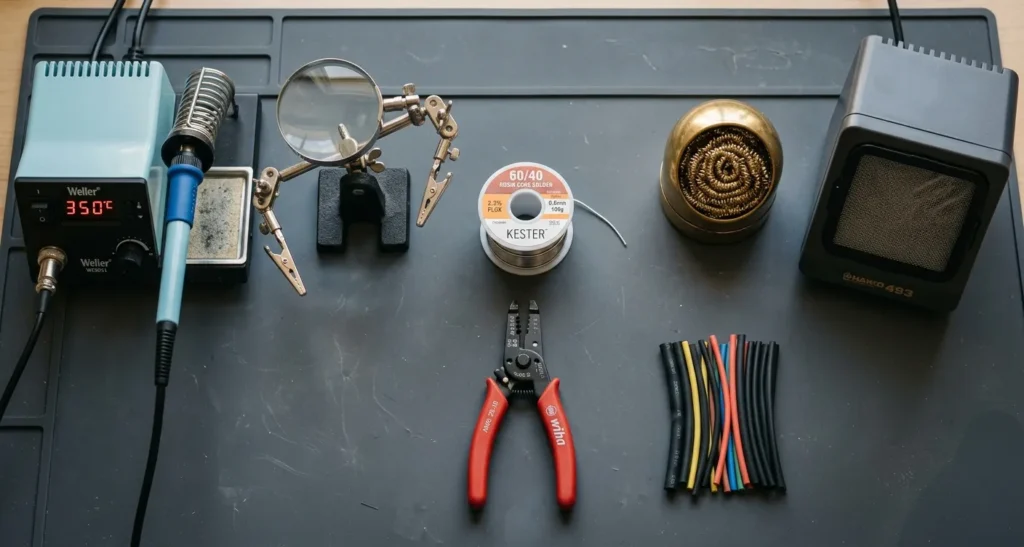
Prior to melting your initial inch of solder wire, it is crucial to verify that your workspace is set up to manage both the heat and smoke. A versatile soldering iron capable of temperature adjustment is essential in this scenario, as the 60/40 solder achieves optimal performance when the tip temperature is consistently regulated. Additionally, you will require a method to keep your work stable; since your hands are limited to two, “helping hands” or a specific holder for soldering wire are essential. These instruments help prevent movement of the wires when the solder is in its malleable phase, which is a primary factor causing unsuccessful, grainy joints in novice projects.
Essential Tools for Soldering Wire to Wire Applications
Prior to melting your initial inch of solder wire, it is crucial to verify that your workspace is set up to manage both the heat and smoke. A versatile soldering iron capable of temperature adjustment is essential in this scenario, as the 60/40 solder achieves optimal performance when the tip temperature is consistently regulated.
- Adjustable Soldering Iron: Seek out a station that allows you to calibrate the temperature to around 300 to 350 degrees Celsius for optimal flow.
- Helping Hands Tool: This device featuring alligator clips secures your soldering wire and components in perfect alignment, allowing you to concentrate on the iron.
- Brass Wire Sponge: In contrast to a wet sponge, a brass cleaner effectively eliminates excess carbon without lowering the temperature of your iron’s tip, significantly enhancing its longevity.
- Fume Extractor: Given that leaded solder emits vapors, having a small fan equipped with a carbon filter is essential for keeping the area safe and breathable.
- Wire Strippers: Quality strippers guarantee that you avoid damaging the copper strands, which could result in weak connections in your electrical circuits later.
- Heat Shrink Tubing: This serves as a professional means to insulate your connections once cooled, offering a much neater appearance compared to standard electrical tape.
Ensuring safety is equally as significant as mastering the technique when working with lead-containing materials. Always cleanse your hands after coming into contact with soldering wire and make certain your workspace is well-ventilated to prevent inhaling inhalants from flux smoke produced during the soldering process.
Maintaining your tools properly, especially by keeping your iron’s tip tinned and polished, is crucial for ensuring the 60/40 alloy behaves reliably each time it encounters a copper pad.
Preparing Your Copper Solder Wire for the Best Bond
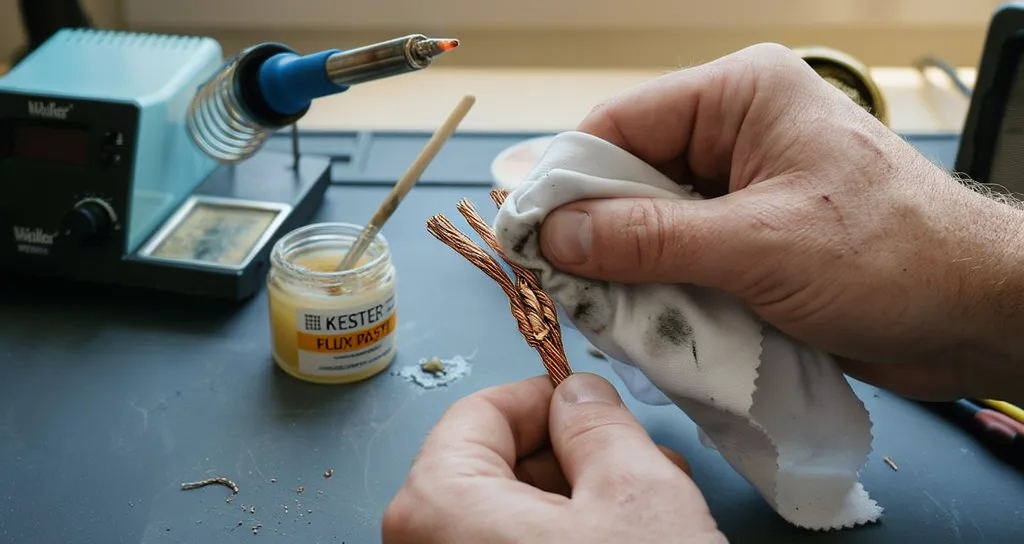
Preparation accounts for 90% of what is necessary for success in any engineering project. When you are poised to connect soldering wire to a component, it is vital that the surfaces are devoid of oil, dirt, and significant oxidation. Even though your 60/40 wire features a rosin core, its capabilities are limited; thoroughly cleaning the copper with some isopropyl alcohol or a fine abrasive pad will expedite the soldering process. This guarantees that the molten metal can create an authentic metallic bond with the substrate, as opposed to merely adhering to a layer of dirt that may ultimately fail.
Mechanical stability represents the subsequent phase in the preparation process. When conducting a wire-to-wire splice, implement a “Western Union” or “Lineman” splice for intertwining the strands prior to introducing the soldering wire. This offers a robust physical linkage so that the solder merely has to establish electrical continuity and secure the connection. A frequent error is to rely solely on the solder to keep two wires together; this results in a fragile joint that can break readily due to vibrations or movements typically found in automotive or portable electronic devices.
6 Essential Steps to Prep Your Wires Before Soldering
Surface De-greasing
Utilize 99% isopropyl alcohol to clean the copper ends by wiping away any finger oils that can obstruct the flow of the alloy.
Mechanical Splicing
Firmly twist the wires together to ensure they remain attached even without solder, guaranteeing optimal physical strength for the connection.
Pre-tinning the Tip
Before beginning, put a small quantity of soldering wire on your iron tip to form a “heat bridge” that facilitates quicker thermal transfer.
Pre-tinning the Wires
Apply a thin layer of solder to each wire individually before joining them; this technique ensures that the final connection is almost instantaneous and neat.
Checking Insulation
Verify that the plastic covering of the wire is pulled back sufficiently so it does not melt or contaminate the joint while heat is being applied.
Flux Application
For wires that are older or significantly oxidized, applying a small amount of external rosin flux paste can enhance the core of your wire, improving wetting.
Once the materials are prepared, the application of heat should not exceed two to three seconds. Excessive heat is detrimental to a quality joint and can burn off the flux before it has the opportunity to perform its function.
The objective is to warm the workpiece rather than the solder; by placing the soldering wire against the heated copper, rather than the iron, you ensure that the metal reaches the necessary temperature to accept the bond.
The 60/40 alloy is particularly effective in “wicking” into the strands of the wire, forming a strong, silver-colored blob that is not only electrically efficient but also visually appealing.
Master the Technique: Applying Solder for Electronics
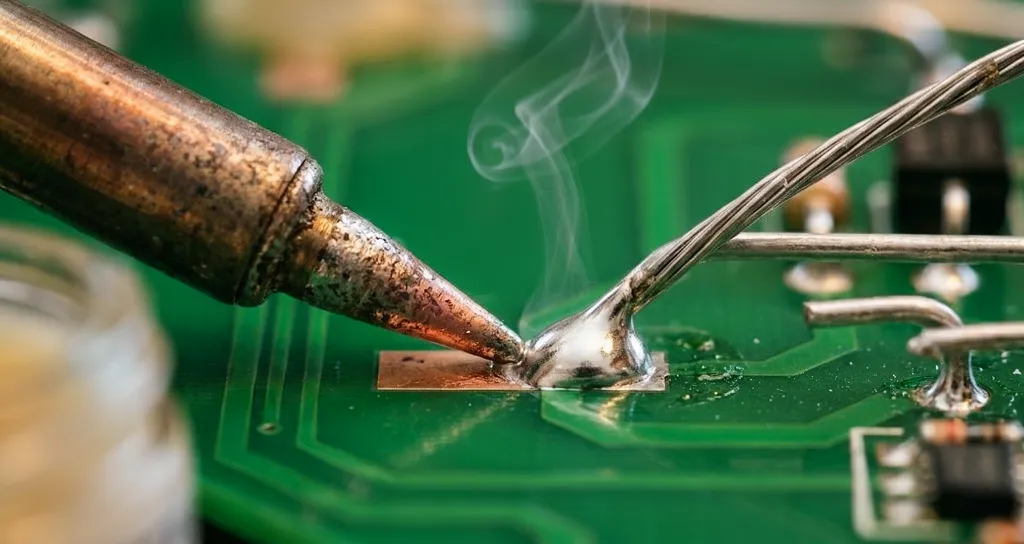
When handling a printed circuit board, the accuracy in applying soldering wire is crucial. The goal is to form a “fillet,” which is a sleek, concave formation resembling a miniature peak that surrounds the component lead. To accomplish this, position your iron tip to make contact with both the copper pad and the lead at the same time. After approximately one second of heating, bring the 60/40 wire into contact with the joint’s opposite side. The solder will liquefy and flow toward the heated area, fully covering the pad and rising slightly on the lead to ensure a secure connection.
If you see solder manifesting as a ball or bead, it typically indicates that either the surface was insufficiently heated or too contaminated for the soldering wire to adhere properly. In such situations, utilizing a de-soldering pump or copper wick to eliminate the existing material and begin anew is advisable. Beginners often attempt to “paint” the solder onto the joint with the iron, which tends to result in cold joints that may fail over time. Keep in mind that it is the iron that heats the metal, which then melts the solder. Understanding this process is crucial, as it differentiates a professional repair from a temporary solution that may falter when the device is jostled.
Common Mistakes When Using 60/40 Rosin Core Solder
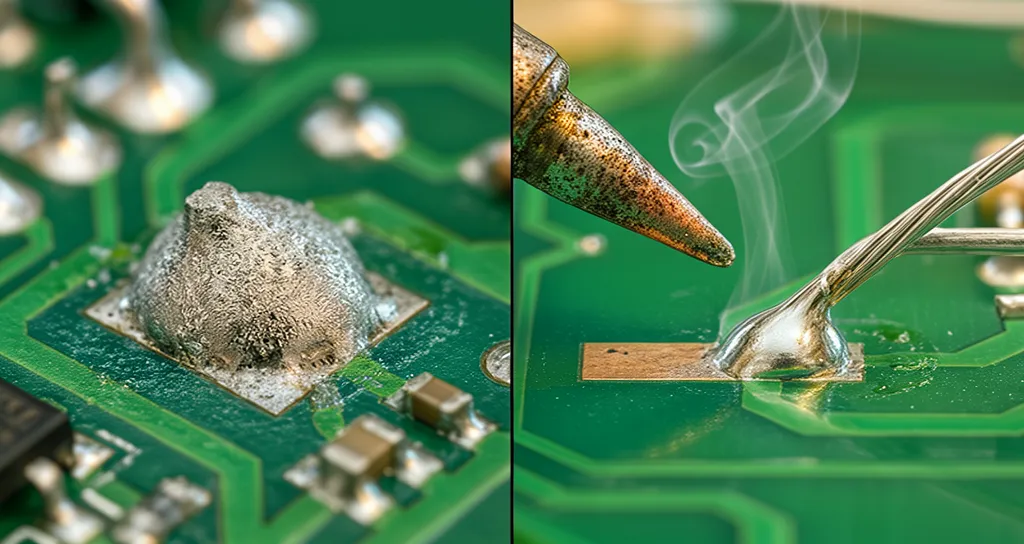
A prevalent mistake involves selecting an incorrect diameter of soldering wire. For delicate electronic components, a diameter between 0.5mm and 0.8mm is preferable, while thicker electrical wiring might necessitate a diameter of 1.0mm or more. Utilizing excessively thick wire for a small PCB pad can result in “solder bridges,” unintentionally connecting distinct points and causing short circuits. It is essential to align the size of your solder with the scale of your project to ensure precise control over the amount of alloy applied in the joint.
Leaving the iron on the joint too long vaporizes the rosin flux completely, resulting in a dull, grey, and fragile connection that fails under stress.
A crystalline or frosted appearance indicates a cold joint, meaning the solder didn’t melt properly and the bond is weak and unreliable.
Even slight vibrations during the “plastic phase” of 60/40 solder create internal cracks that destroy the electrical connection permanently.
Impatience during cooling causes microscopic fractures invisible to the eye but fatal to conductivity and long-term durability.
A proper 60/40 solder joint should always look bright and shiny. Dull, grey, or textured surfaces are visual red flags of a flawed connection.
The rosin core flux must survive the heating process to clean the surfaces. Holding heat too long burns it away before it can do its job, leaving oxidation behind.
Another frequent error is “over-heating,” which occurs when the iron remains on the joint for an excessive duration. This leads to the complete vaporization of the rosin flux, resulting in a dull, grey, and fragile joint. With 60/40 solder, the outcome should consistently appear bright and shiny. If it has a crystalline or frosted appearance, it signifies a cold joint. Additionally, refrain from moving the components while the solder cools; even slight vibrations during the “plastic phase” of 60/40 can lead to internal cracks that compromise the electrical connection.
Soldering Wire Technical Specifications and Data
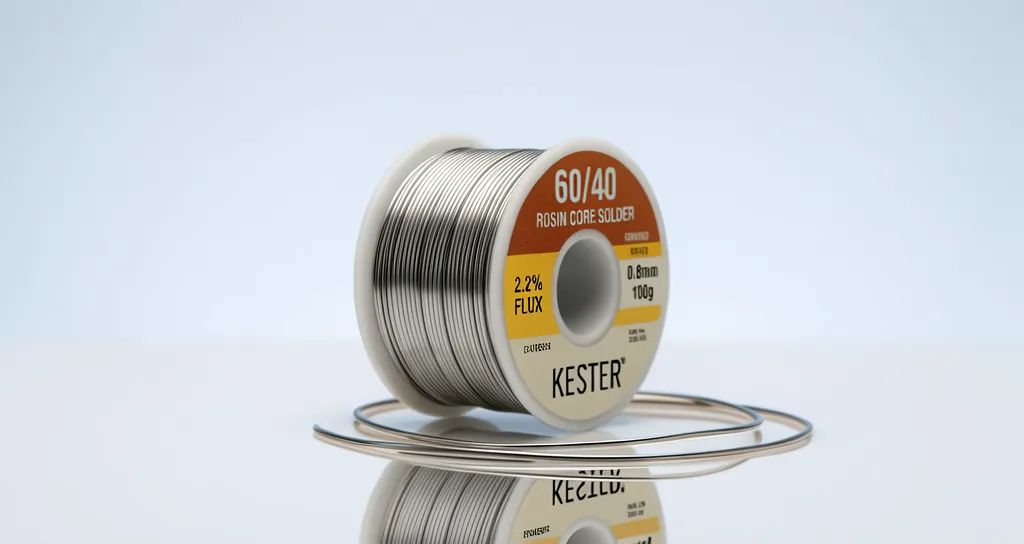
The 60/40 solder wire continues to be a fundamental choice due to its favorable technical characteristics. Although industrial producers are shifting towards lead-free alternatives to adhere to environmental standards like RoHS, the 60/40 mixture remains commonly utilized in repair tasks and hobbyist activities because it delivers exceptional performance.
| Feature | 60/40 Solder Detail | Best Use Case |
|---|---|---|
| Alloy Composition | 60% Tin / 40% Lead | General Electronics & DIY |
| Melting Point | 183°C – 190°C (361°F – 374°F) | Heat-sensitive components |
| Flux Type | Rosin Core (Non-Corrosive) | Circuit boards and wiring |
| Diameter Range | 0.5mm to 1.5mm | Precision to heavy duty |
| HSN Code | 80030010 | Business & Export Tracking |
| Appearance | Bright, Shiny Silver | High-quality electrical joints |
Leaded Solder Versus Lead-Free Soldering Wire
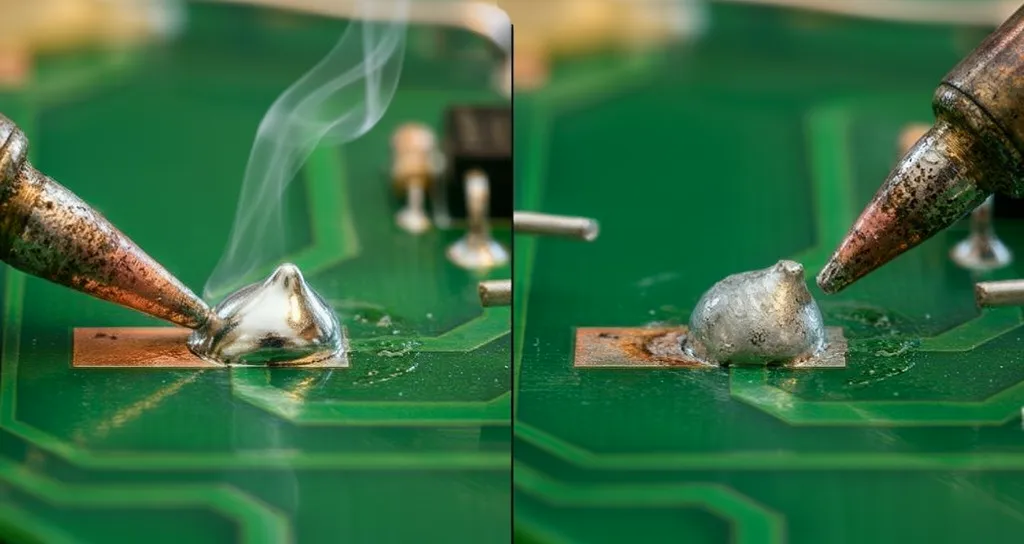
Deciding between leaded and lead-free options presents a significant decision point for any creator. Conventional solder wires, such as the 60/40 or 63/37 varieties, include lead, which enhances the fluidity of the metal and lowers the melting point. This reduction in required heat makes it safer for novices, who could unintentionally lift a copper pad or damage a transistor by applying the iron to the board for an excessive duration. In contrast, lead-free solder, usually composed of tin, silver, and copper, demands significantly higher temperatures and often results in a dull appearance that complicates the visual assessment of the joint’s quality.
For professional uses and consumer goods distributed worldwide, the lead-free option has become the standard due to health and environmental considerations. However, for individual projects, restoration of older equipment, or learning basics, experts frequently suggest 60/40 soldering wire for its simplicity. If you opt for leaded solder, make sure to have a dedicated work area that children and pets cannot reach, and always utilize a fan to disperse the fumes from the flux away from your face. The trade-off in user-friendliness is considerable, enhancing the ease of learning for those new to hardware.
Leaded Solder (60/40) vs Lead-Free Solder: Key Advantages Compared
In conclusion, while lead-free is more beneficial for the environment, 60/40 is often advantageous for building a novice’s confidence. If you are honing your skills with soldering electrical wires, the accommodating nature of 60/40 will enable you to learn how the metal should flow without the added challenge of managing high temperatures.
As you gain experience, you may want to try 63/37 (eutectic) solder, which transitions from liquid to solid immediately, or lead-free varieties once your speed and precision have advanced.
Shifting from 60/40 to other alloys becomes significantly easier once you have developed a sense of how a proper metallic bond is created.
Advanced Insights for Utilizing De-Soldering Wire and Wick
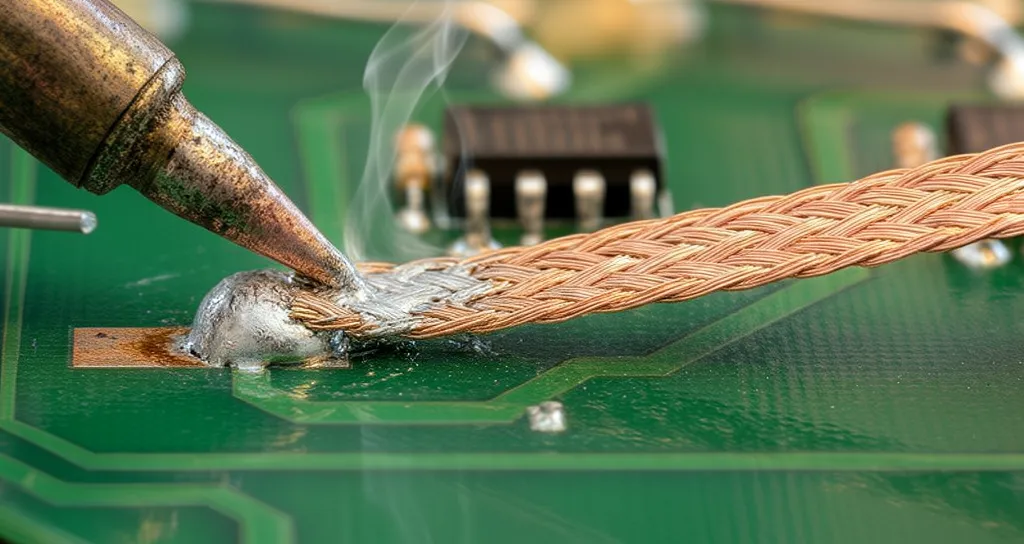
Errors are a natural aspect of the learning journey, and the ability to rectify them distinguishes a skilled technician. In cases where excessive solder wire is applied or a connection bridge is formed, de-soldering wire, also referred to as solder wick, becomes essential. This wick consists of a fine copper braid treated with flux, functioning like a sponge for liquid metal. To use it, position the wick over the unwanted solder, press the soldering iron onto the braid, and allow the heat to pull the excess solder into the copper mesh.
Always Use a Fresh Wick Section
Each removal requires a clean segment of wick to achieve maximum absorption. Reusing old wick reduces efficiency and leaves solder residue behind.
Re-activate Stubborn Solder with Fresh 60/40
If the solder refuses to flow, add a tiny droplet of new 60/40 wire to reintroduce active flux and restart the wicking process instantly.
Clean Residue with Alcohol After Desoldering
Once excess solder is removed, wipe the area with alcohol to clear sticky rosin leftovers and prepare the surface for a fresh connection.
Master the Wick to Experiment Fearlessly
Knowing how to fix mistakes gives you the confidence to practice without fear of permanently damaging expensive components or circuit boards.
The more frequently you engage with soldering wire, the more second nature the technique will become. You will begin to identify the precise moment when the metal is ready to flow and the exact instant to withdraw the iron.
Whether you are constructing a customized drone, fixing a guitar cable, or designing a new IoT device, the basic 60/40 solder wire serves as the adhesive for our modern digital environment.
Caring for Your Setup for Continued Success
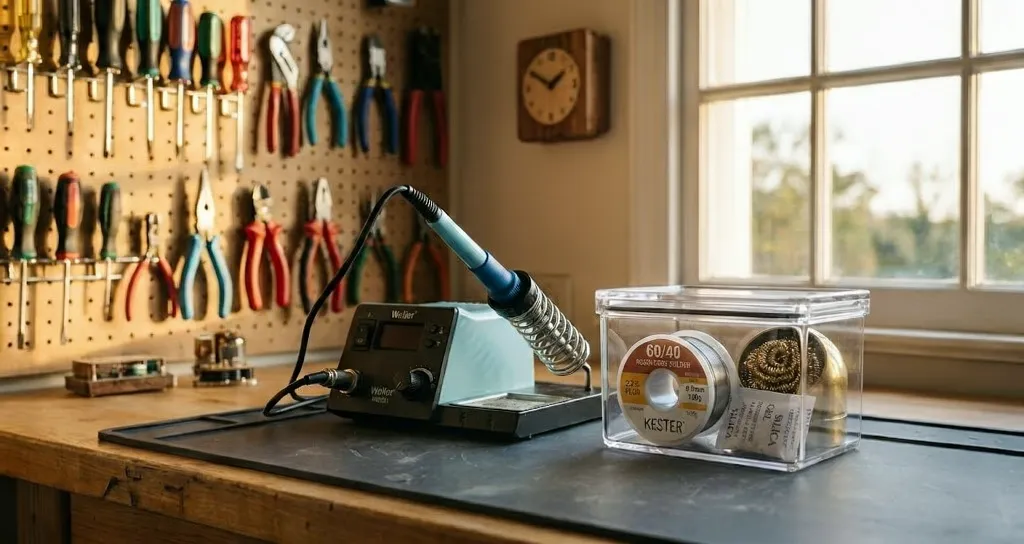
To ensure your soldering wire functions at its best, you must safeguard your tools from environmental conditions. Always “tin” the tip of your iron before shutting it off, which involves leaving a generous layer of fresh solder on it to prevent oxidation during cooling. An oxidized tip will hinder heat transfer, making even top-quality 60/40 solder feel sluggish and challenging to manage. Keep your solder rolls in a dry area to avoid degradation of the rosin core and prevent the exterior lead layer from forming a heavy oxide crust.
Lastly, maintain an inquisitive mindset and continue practicing on scrap materials before tackling your main projects. The realm of soldering wire is extensive, encompassing everything from industrial-grade machine wire to high-precision alloys used in smartphone repairs. By beginning with 60/40, you’re establishing a skill set that will be beneficial across various technical fields. With persistence, appropriate tools, and a steady hand, you will soon be capable of producing high-quality electronics designed to endure a lifetime.