





Understanding Bluetooth Classic and BLE Technologies
When engineers and IoT product designers first face the wireless module selection process, the BLE vs Bluetooth Classic difference becomes the single most important fork in the road. Bluetooth Classic technology, also known as Bluetooth Basic Rate/Enhanced Data Rate (BR/EDR), was introduced in the late 1990s and has evolved steadily to support continuous, high-throughput data streams. It operates on 79 channels in the 2.4 GHz ISM band, using adaptive frequency hopping to maintain robust connections between devices like smartphones, headsets, and in-car infotainment systems. Its architecture is built around connection-oriented links, meaning once a Classic Bluetooth protocol link is established, it stays open for as long as the application needs it—making it ideal for audio streaming or file transfers where data flows continuously.
Bluetooth Low Energy (BLE), first released with the Bluetooth 4.0 and above specification, is an entirely different wireless communication protocol tailored for ultra-low-power applications. Instead of maintaining a persistent connection, BLE technology features a connectionless framework where the radio wakes up for a few milliseconds, exchanges tiny packets of data, and goes back to sleep. This fundamental change in the link layer reduces power consumption in BLE to a fraction of what Classic Bluetooth demands. BLE uses 40 channels (3 advertising and 37 data channels) and can complete a connection and data exchange in under 3 ms, compared to the 100 ms typical in Classic. For an embedded systems engineer, the Bluetooth versions comparison is not about one being better—it’s about understanding that BLE and Classic serve almost opposite use cases despite sharing the same brand name.
Key Differences Between BLE and Bluetooth Classic
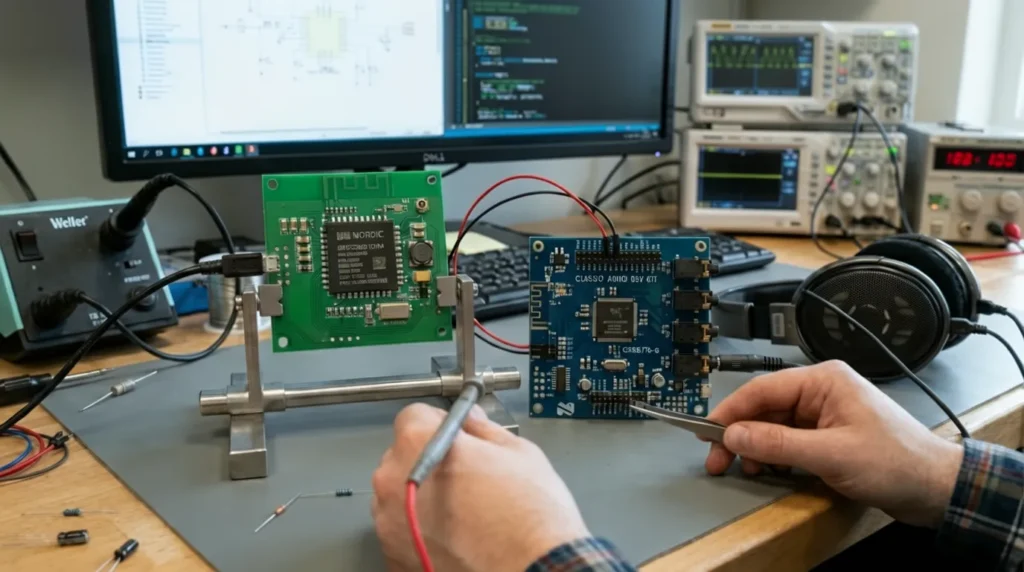
The BLE vs Bluetooth Classic difference becomes crystal clear when you look under the hood at the protocol stacks and physical layer designs. Classic Bluetooth protocol is structured around profiles like A2DP (Advanced Audio Distribution Profile) and HFP (Hands-Free Profile), which were optimized from day one for bandwidth-hungry, latency-sensitive tasks. It offers a data transfer speed Bluetooth Classic of up to 2.1 Mbps (EDR) and supports synchronous connection-oriented (SCO) links for voice. BLE, on the other hand, operates via the Generic Attribute Profile (GATT), which defines how two low energy wireless communication devices exchange attribute data in a server-client model. Its maximum throughput in Bluetooth Classic is not the goal; rather, BLE prioritizes short bursts with an effective throughput usually around 0.27 Mbps, which is enough for sensor values but nowhere near enough for uncompressed audio.
While Classic Bluetooth expects devices to stay connected and maintain a steady energy budget, BLE was born for coin-cell-powered gadgets that send a few bytes every second or even once an hour. The latency difference BLE vs Classic is also significant—BLE can achieve connection intervals as low as 7.5 ms, giving it a huge advantage in responsiveness for wearables and smart home sensors. However, when it comes to streaming, Classic Bluetooth’s isochronous channels offer a predictable latency that keeps audio perfectly synced. The two protocols share the same 2.4 GHz carrier but differ radically in Bluetooth vs BLE frequency utilization, with BLE using Gaussian Frequency Shift Keying (GFSK) modulation at 1 Msym/s and Classic employing more complex phase modulation for higher data rates.
Key differences summarized:
BLE technology features and the Classic Bluetooth protocol each represent an optimization opposite. Optimizing for power usually means sacrificing continuous data flow, while optimizing for audio fidelity means accepting higher energy consumption. These engineering choices directly influence battery size, enclosure design, and the overall product experience.
What many hardware designers miss early on is that the wireless communication protocols selection trickles down to firmware complexity and certification costs. BLE stacks tend to be smaller and easier to qualify, while Classic Bluetooth stacks demand a robust RF frontend and more PCB area. A wrong assumption here can force a complete redesign six months into a product cycle.
Performance and Range Comparison
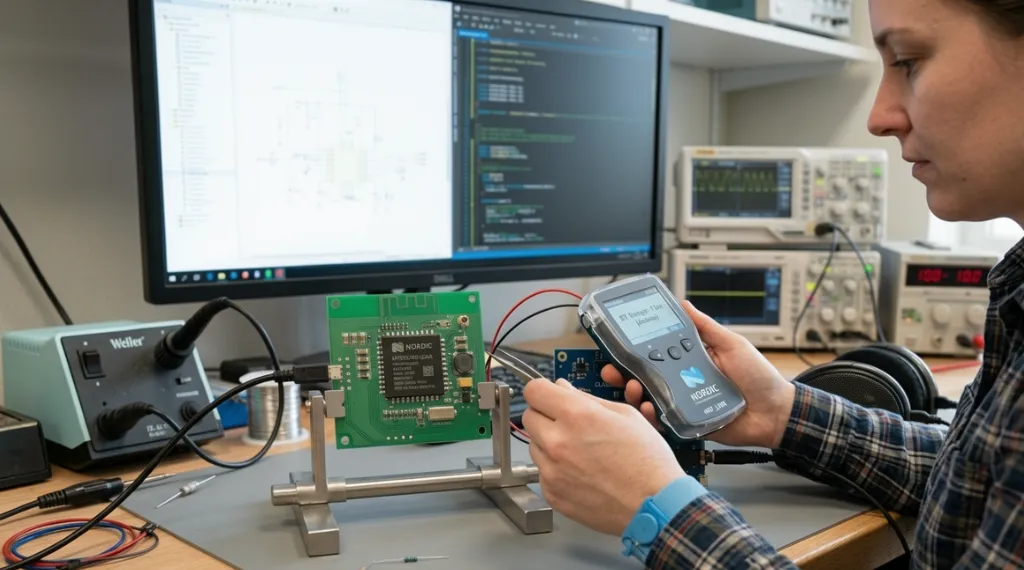
A practical side of the BLE vs Bluetooth Classic difference that engineers constantly ask about is range, and the answer is nuanced. In open air, both Classic Bluetooth and BLE—especially with Bluetooth 5’s coded PHY—can reach 200 meters or more under ideal conditions. Typical ble vs bluetooth range in an office environment, however, sits around 10–30 meters for Classic and 30–50 meters for BLE when using LE Coded. The subtle advantage BLE holds in range is often due to its simpler modulation and the ability to use multiple advertisement channels that increase the chance of a packet getting through. For industrial IoT communication, that extra 10 meters of reliable coverage can eliminate a repeater node entirely.
Range comparison Bluetooth types must also account for interference and multipath effects. Because Classic uses 79 narrow-band channels and BLE uses 40 slightly wider channels, BLE’s channel spacing can perform better in the presence of Wi-Fi interference. Meanwhile, the power consumption in BLE remains dramatically lower even when transmitting at the same output power—typically 0 dBm—because the duty cycle is orders of magnitude smaller. In a system performing a 20-byte sensor update once per second, a BLE radio might average 3 µA of current, whereas a Classic Bluetooth radio maintaining an ACL link would draw tens of milliamps continuously. The difference in battery life optimization BLE offers can extend device lifetime from days to years.
Performance Factors in BLE vs Bluetooth Classic
When comparing BLE and Bluetooth Classic for IoT devices, engineers must evaluate several real-world performance factors including range, throughput, latency, connection speed, interference handling, and overall power efficiency.
- Range in Real Environments: Bluetooth Classic (BR/EDR) is typically limited to a single room when walls or obstacles are present. BLE using the 125-kbps coded PHY can penetrate multiple walls, making it highly effective for smart sensor communication in homes and industrial spaces.
- Data Transfer Speed Bluetooth Classic vs BLE: Bluetooth Classic supports up to 2.1 Mbps, while BLE 4.x reaches around 0.27 Mbps and BLE 5 can achieve up to 2 Mbps in high-speed mode. However, BLE high-speed mode reduces range significantly, so most IoT devices operate with lower practical throughput.
- Latency for Time-Critical Applications: BLE can achieve connection intervals as low as 2.5 ms with optimized configuration, whereas Bluetooth Classic typically operates around 5 ms minimum polling intervals. This makes BLE better for responsive applications like haptic feedback systems and emergency stop controls.
- Connection Setup Time: BLE can discover, connect, exchange data, and disconnect in under 3 milliseconds. Bluetooth Classic pairing and discovery often take between 1–2 seconds, which is inefficient for low-power devices that wake briefly to transmit sensor data.
- Coexistence with Wi-Fi and Other 2.4 GHz Radios: Both BLE and Bluetooth Classic use adaptive frequency hopping, but BLE’s shorter packet durations and optimized channel usage help reduce packet loss and improve reliability in crowded wireless environments.
- Energy Efficiency for Bursty Traffic: The BLE vs Bluetooth Classic difference becomes most obvious in low-duty-cycle IoT applications. BLE sleep currents can drop to 0.1 µA, allowing battery-powered sensors to operate for years, while Bluetooth Classic would quickly drain small batteries even in deep sleep conditions.
Engineers prototyping an embedded systems wireless module often find that BLE meets 90% of their IoT needs, and they only reach for Classic when bidirectional audio or continuous streaming is a hard requirement. This realization leads to simpler hardware layouts and far longer battery life.
IoT Devices: Why the Protocol Choice Changes Everything
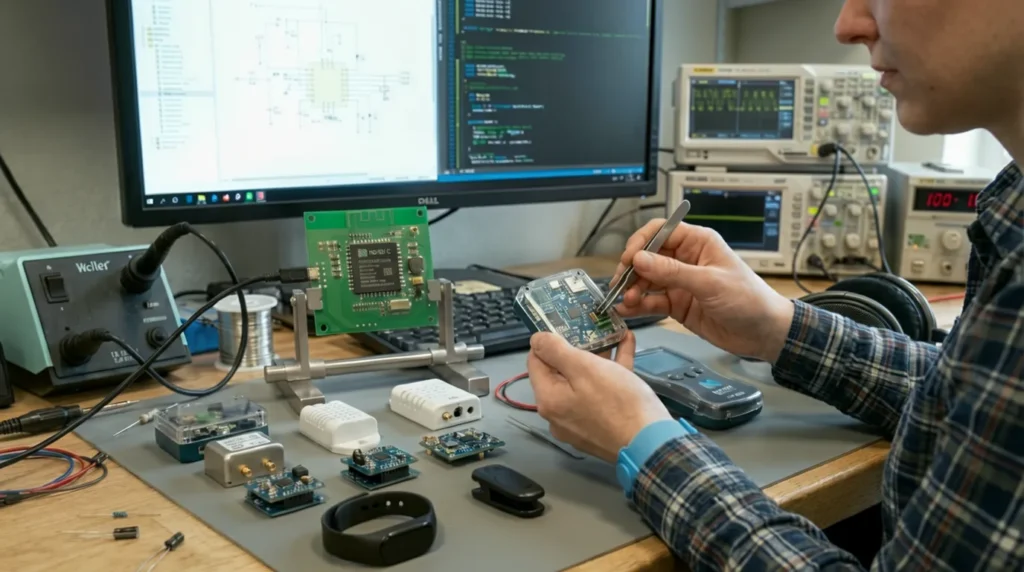
The BLE vs Bluetooth Classic difference shapes not just the radio but the entire IoT devices connectivity architecture. If you’re building a wearable devices Bluetooth technology product like a fitness tracker or a blood pressure monitor, BLE is the natural choice. The device can synchronize a day’s worth of data with a phone in a few seconds once a user opens the companion app, then return to an almost zero-power state. This mode of operation is impossible with Classic Bluetooth because maintaining a link suitable for that sporadic data dump would waste enormous energy during the 99.9% idle time. The resulting design philosophy is fundamentally different: BLE encourages event-driven, sleepy-node architectures, while Classic encourages always-connected peripherals with more generous power budgets.
On the industrial side, the choice affects scalability and network topology. Classic Bluetooth piconets are limited to seven active slaves, which is a non-starter for a smart building application that needs 200 temperature sensors talking to a single gateway. BLE, through advertising extensions and mesh networking, can support thousands of nodes. This scalability, paired with the BLE vs Bluetooth classic difference in power profile, makes sensor grids practical. Industry engineers who once defaulted to Wi-Fi are now moving to BLE for its unmatched battery life optimization and the ability to wake sensors on a schedule set over the network.
Real-World IoT Applications Where BLE vs Bluetooth Classic Matters
Wearable Health Monitors
Heart rate, SpO₂, and ECG wearable patches using BLE can operate for 7–14 days on a CR2032 battery. Bluetooth Classic would require larger rechargeable batteries and frequent charging, making lightweight disposable designs impractical.
Asset Tracking Tags
BLE beacons broadcasting once per second can track tools and equipment across factory floors while maintaining battery life for multiple years. Bluetooth Classic is rarely considered because continuous connection overhead drains batteries rapidly.
Smart Home Sensors
Door sensors, leak detectors, and motion sensors depend on BLE’s ultra-low sleep current capability. A Bluetooth Classic implementation would significantly increase long-term battery replacement costs.
Audio Devices Bluetooth Classic Use
Wireless earbuds, speakers, and automotive hands-free systems require continuous high-quality audio streaming. Although BLE Audio with the LC3 codec is evolving quickly, Bluetooth Classic profiles like A2DP and HFP remain the preferred choice for mature audio products.
Industrial IoT Communication
Industrial vibration sensors can process machine health data locally and transmit anomaly alerts using BLE. This low-power edge processing model is practical because BLE minimizes wireless power consumption.
Fitness Trackers BLE Usage
Fitness bands and smart trackers periodically synchronize steps, heart rate, and activity summaries. BLE throughput is more than sufficient for these small data transfers while extending battery life to a full week or longer.
In every embedded system wireless module selection meeting, the conversation starts with the data pattern—continuous or bursty—and that one question often points directly at BLE for IoT. It’s not that Classic cannot serve sensors; it’s that the resulting product would be bulky, expensive, and commercially unviable when competing against BLE-based solutions.
The engineering perspective on range also shifts when you realize that BLE mesh can relay messages across a factory floor, something Classic’s piconet model simply cannot do. This capability turns simple sensors into a resilient mesh infrastructure.
For startups and hardware developers, the BLE vs Bluetooth Classic difference often translates into time-to-market: BLE modules from Nordic, TI, or Espressif come with pre-certified stacks and reference designs, while Classic Bluetooth products require more extensive RF testing. A prototype built using BLE can transition from breadboard to pilot production in weeks, not months.
Engineering Design Considerations: PCB and Firmware
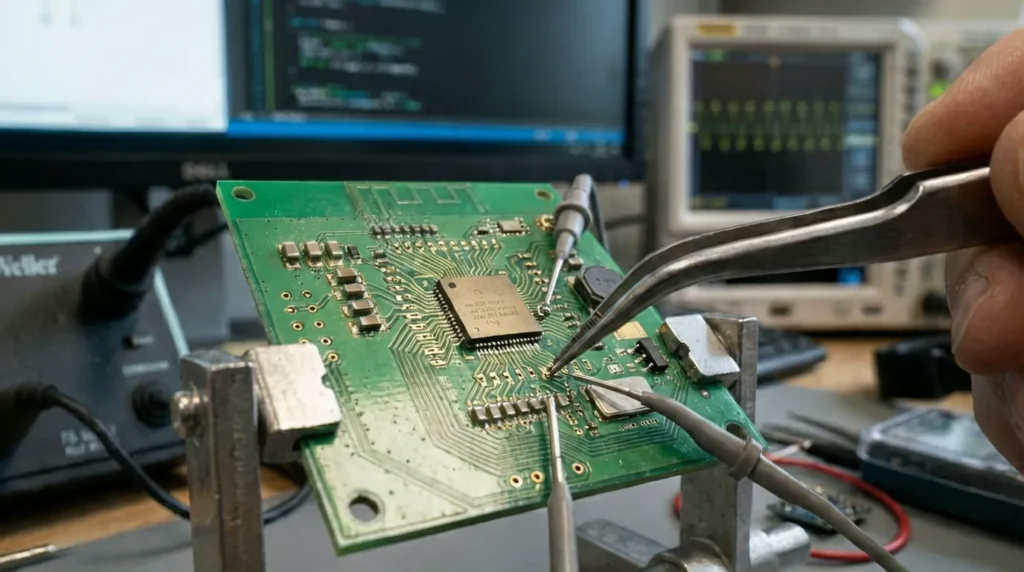
Every seasoned hardware engineer knows that the BLE vs Bluetooth Classic difference starts at the schematic sheet and PCB stack-up. In BLE designs, the transceiver’s peak current draw rarely exceeds 15 mA, which often lets you power the entire device from a single-cell battery with a small LDO and minimal decoupling. Classic Bluetooth hardware, by contrast, can demand 40–60 mA during active transmission, forcing you to design for thermal dissipation and larger power traces. At Prototype Guru, we always advise clients to simulate the power delivery network early; a BLE board can tolerate a simple two-layer FR4, while a Classic board frequently needs a four-layer stack to keep the RF path stable.
BLE software stacks such as Nordic SoftDevice and TI BLE-stack are highly optimized and event-driven, typically fitting within 80–100 kB of flash memory for compact IoT firmware development.
Bluetooth Classic stacks are significantly larger and often tightly integrated with real-time operating systems, increasing firmware complexity and memory requirements.
BLE firmware commonly uses interrupt-based and event-driven communication models, helping developers reduce CPU usage and improve battery efficiency in embedded systems.
Bluetooth Classic implementations generally require more advanced RTOS scheduling because synchronous audio links and continuous communication demand precise timing control.
Hardware prototyping BLE devices can often operate using lightweight RTOS platforms or even bare-metal firmware, simplifying development and reducing system overhead.
Bluetooth Classic firmware typically requires more careful management of synchronous links, scheduler timing, and power states, making certification and low-power optimization more difficult.
The choice of wireless communication protocols also influences antenna design. BLE’s burst-nature communication is more forgiving of impedance mismatches, while Classic’s continuous streaming magnifies any VSWR problem. As a result, the RF communication in embedded systems using BLE can be realized with a simple chip antenna and proper keep-out zones, saving both cost and PCB real estate. Prototype Guru has helped numerous startups compress their entire IoT sensor into a 20×15 mm board by pushing BLE integration to its limits—an impossibility with Classic without sacrificing battery life.
Selecting the Right Module for Your Product
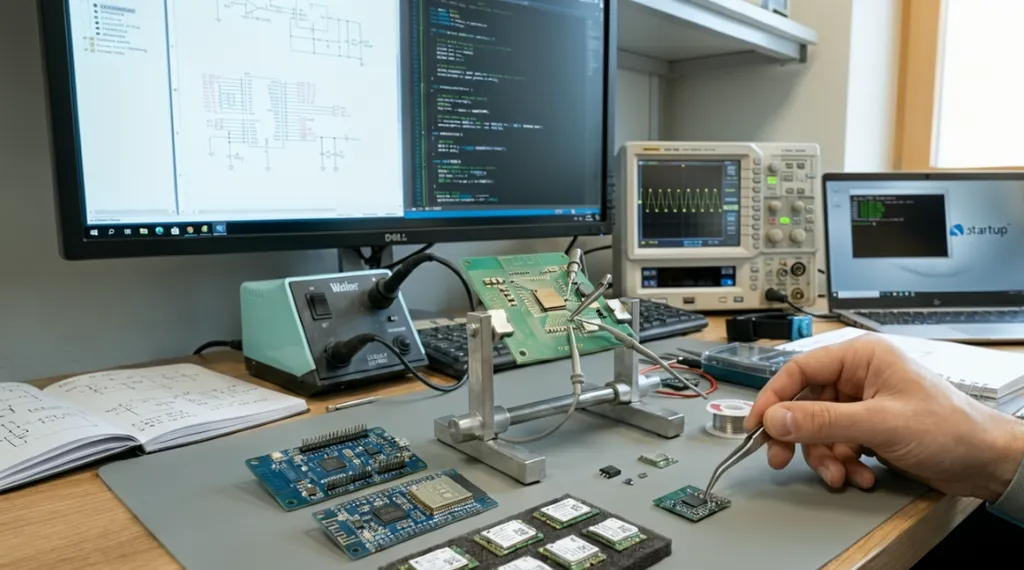
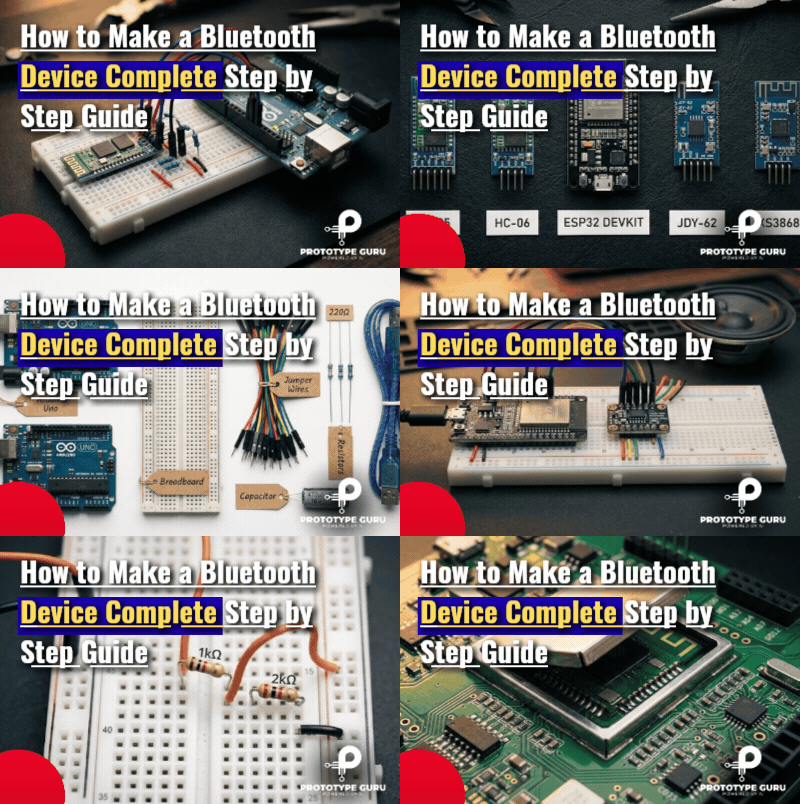
Selecting a wireless module selection guide is where the BLE vs Bluetooth Classic difference gets translated into part numbers and development kits. If your product sends short bursts of telemetry data, a BLE System-on-Chip (SoC) like the nRF52840 or ESP32‑C3 becomes the obvious choice. These microcontrollers integrate the radio, processor, and flash, letting you do everything on one piece of silicon. When you need Bluetooth classic flutter integration—for example, an app that streams audio to a Flutter-based mobile UI—you typically end up with a dual-mode module like the ESP32, which supports both BLE and Classic. This dual-mode capability adds cost but gives you flexibility during the embedded firmware Bluetooth integration phase.
Many IoT product developers begin with a BLE module for the sensor side and later realize they need Classic for a gateway that bridges to an A2DP sink. Understanding this early can prevent a board re-spin. At Prototype Guru, our typical recommendation is to start with a dual-mode chip in the gateway and pure BLE in endpoints—this balanced approach keeps the per-node BOM under $5 while providing the full protocol toolbox at the aggregator.
| Feature | BLE (nRF52840 / CC2640) | Dual-Mode ESP32 | Classic-Only Module (BC417) |
|---|---|---|---|
| Primary Use | Low-power sensor, wearable, beacon | Gateway, dual-mode audio + sensor hub | Audio headset, hands-free car kit |
| Peak TX Current | ~6 mA @ 0 dBm | ~200 mA @ 20 dBm (Wi-Fi + BT) | ~40 mA @ 4 dBm (BR) |
| Sleep Current | ~0.4 µA (system off) | ~5 µA (deep sleep) | ~200 µA (sniff mode) |
| Throughput | 0.27–2 Mbps (BLE 5) | ~2.1 Mbps (Classic) / 1.4 Mbps (BLE 4.2) | 2.1 Mbps (EDR) |
| Range (Indoor, Typical) | 30–50 m (Coded PHY) | 15–30 m (Classic), 20–40 m (BLE) | 10–30 m |
| Stack Size (Flash) | 80–120 KB | 400+ KB (includes Wi-Fi stack) | 250–400 KB |
| Certification Complexity | Low (pre-certified modules available) | Medium (pre-certified, but requires RF co-existence testing) | Medium-High |
Engineers who pin down their data pattern, duty cycle, and power budget before choosing a module avoid the classic (pun intended) mistake of over‑engineering the radio. That one table often saves two months of wasted prototyping time.
Application Scenarios in Wearables, Audio, and Industrial IoT
The BLE vs Bluetooth Classic difference shows up vividly when you map each protocol to a real vertical. Consider a smart ring that tracks sleep. It wakes every few minutes, logs accelerometer peaks, and at 7 AM syncs the night’s data in under 200 ms using BLE. The whole operation consumes less than 20 µAh per day, enabling a week‑long runtime on a 20 mAh battery. If a designer forced Classic onto that ring, the pairing delay and link maintenance would drain the battery before lunch. The wearable ecosystem is therefore almost entirely BLE‑based, from fitness trackers to continuous glucose monitors; the low energy wireless communication is not just a benefit, it’s the enabler.
On the opposite side, an in‑car infotainment system needs to stream navigation audio, answer calls, and maintain a phonebook contact sync—all simultaneously. Classic Bluetooth protocol handles this with A2DP, HFP, and PBAP profiles running over a robust, always‑present ACL link. The data transfer speed Bluetooth Classic provides is non‑negotiable for this use case, and the vehicle’s alternator makes power consumption irrelevant. This is why Classic remains deeply embedded in automotive and high‑fidelity audio devices Bluetooth Classic use, despite BLE’s emergence. Yet, the industry is shifting: BLE Audio with the LC3 codec promises to cover these scenarios at lower power, showing that the BLE vs Bluetooth Classic difference is not static but evolving.
When to Choose BLE
Bursty sensor data uploads with long idle periods where ultra-low power consumption is critical.
Coin-Cell Battery Devices
Ideal for CR2032-powered systems where multi-year battery life is required without frequent replacement.
BLE Mesh Networking
Suitable for large-scale sensor networks where devices relay data across nodes in smart building or industrial systems.
Asset Tracking Labels
Perfect for low-power beacons that periodically broadcast location data in warehouses or factories.
Ultra-Low Standby Current
Best for systems requiring nanoamp-level sleep currents to maximize battery lifespan.
Small Memory Footprint
Suitable for microcontrollers with limited flash and RAM where lightweight BLE stacks are preferred.
When to Choose Classic Bluetooth
Continuous audio streaming applications where stable, uninterrupted high-bandwidth transmission is required.
Hands-Free Calling (HFP)
Used in headsets and car kits where real-time voice communication and low jitter are essential.
File Transfer & OBEX
Suitable for legacy file sharing systems where OBEX protocol support is still required.
High-Throughput HID Devices
Best for controllers, keyboards, and peripherals needing consistent higher data rates and responsiveness.
SPP Legacy Compatibility
Required for older industrial or embedded systems still using Serial Port Profile (SPP) communication.
Simultaneous A2DP + HFP Usage
Needed in headsets and infotainment systems that handle music streaming and voice calls at the same time.
A factory floor illustrates the smart sensors communication scenario best. Vibration sensors on a CNC machine transmit spectrum data once every ten minutes via BLE to a gateway. That gateway then uses Classic Bluetooth to feed a loudspeaker that announces maintenance alerts. You get BLE for low‑power sensing and Classic for voice—each doing what it does best. Over‑laying a single protocol across the entire system would be inefficient; the real skill is blending them.
Developing for both protocols within the same firmware requires careful partitioning. At Prototype Guru, we often structure the task scheduler so the BLE stack runs with higher priority for sensor data, while the Classic audio pipeline gets a dedicated DMA channel. That clean separation avoids the Bluetooth vs bluetooth le discord that can arise from stack conflicts.
PrototypeGuru End-to-End Bluetooth & IoT Product Development Services
Building a successful Bluetooth-enabled product requires much more than selecting between BLE and Bluetooth Classic. At PrototypeGuru, we provide complete hardware and IoT development solutions that help startups and businesses transform ideas into production-ready devices with faster development cycles and lower engineering risks. Our team works closely with clients to optimize wireless performance, power efficiency, firmware stability, manufacturability, and long-term scalability for modern connected products.
From low-power BLE wearables and industrial IoT sensors to Bluetooth Classic audio devices and smart consumer electronics, our engineering approach focuses on creating reliable and market-ready solutions. By combining hardware expertise with embedded software development and manufacturing support, we help companies reduce redesign costs, improve product quality, and accelerate time-to-market while ensuring compliance with global industry standards.
Our Services at PrototypeGuru
Design
Creative product and industrial design solutions.
Prototyping
Rapid prototyping and concept validation services.
Embedded & Software Development
Embedded systems and software engineering solutions.
Manufacturing & Production
Efficient production and manufacturing support.
Product Launch Support
End-to-end launch and market entry assistance.
Quality, Compliance & Certification
Compliance testing and certification management.
Benefits of Working with PrototypeGuru
Choosing PrototypeGuru gives your product access to complete end-to-end engineering expertise under one roof. Our Design and Prototyping services help validate ideas faster while minimizing costly hardware revisions during development. Through Embedded & Software Development, we optimize Bluetooth communication, firmware stability, and low-power performance for real-world IoT applications. Our Manufacturing & Production support ensures smooth transition from prototype to scalable production with reliable component sourcing and assembly processes. We also provide Product Launch Support to help businesses prepare for market deployment efficiently, while our Quality, Compliance & Certification services ensure your device meets industry standards and regulatory requirements. This integrated workflow reduces development time, lowers production risk, improves product reliability, and helps businesses launch competitive Bluetooth and IoT products with confidence.
Implementation Roadmap and Final Thoughts
From idea to deployed IoT product, the BLE vs Bluetooth Classic difference influences every milestone on the implementation roadmap. The first step is always to capture the data flow diagram—when does the device talk, how much does it say, and how fast must it respond? An honest inventory of these parameters usually reveals the protocol; very few products genuinely need both. Once the protocol is locked, the hardware team can design the PCB for the selected Bluetooth module, ensuring the antenna matching network and ground plane align with the module manufacturer’s guidelines. RF simulation and pre‑compliance tests then validate that the wireless communication protocols perform as expected in the target enclosure.
Moving into firmware, the IoT product development Bluetooth phase demands a clear separation between the application logic and the wireless stack. BLE APIs are generally callback‑driven, which naturally leads to an event‑loop architecture. Classic Bluetooth’s synchronous data pipes require careful buffer management to avoid underflow during audio streaming. This is where Prototype Guru’s 15+ years in embedded design pay off: we have a library of proven BSPs and host controller interface (HCI) flows that cut the integration time by half. The final step before mass production is a thorough battery‑life characterization under real‑world usage patterns, verifying that the low energy wireless communication promise matches the datasheet.
The investment in one protocol over the other isn’t just technical; it’s strategic. Choosing BLE may lower your per‑unit cost and lengthen battery life, but if your market demands stereo audio, you’ll need Classic. Increasingly, we guide clients toward dual‑mode SoCs for gateway products and pure BLE for edge nodes. This hybrid approach balances the BLE vs Bluetooth Classic difference across the system, letting each radio technology shine where it is strongest. The final board spins we do at Prototype Guru routinely shave 40% off the BOM and accelerate certification by two months compared to when clients come to us with mismatched protocol assumptions.
If you’re deep in wireless module selection and feeling stuck, remember that the BLE vs Bluetooth Classic difference comes down to data pattern and power. Map those first, and the hardware decisions become almost mechanical. And if you ever need an expert pair of hands to turn that decision into a manufacturable board, we at Prototype Guru have the RF labs and firmware teams ready to accelerate your journey.