




What Is an EMI EMC Filter?
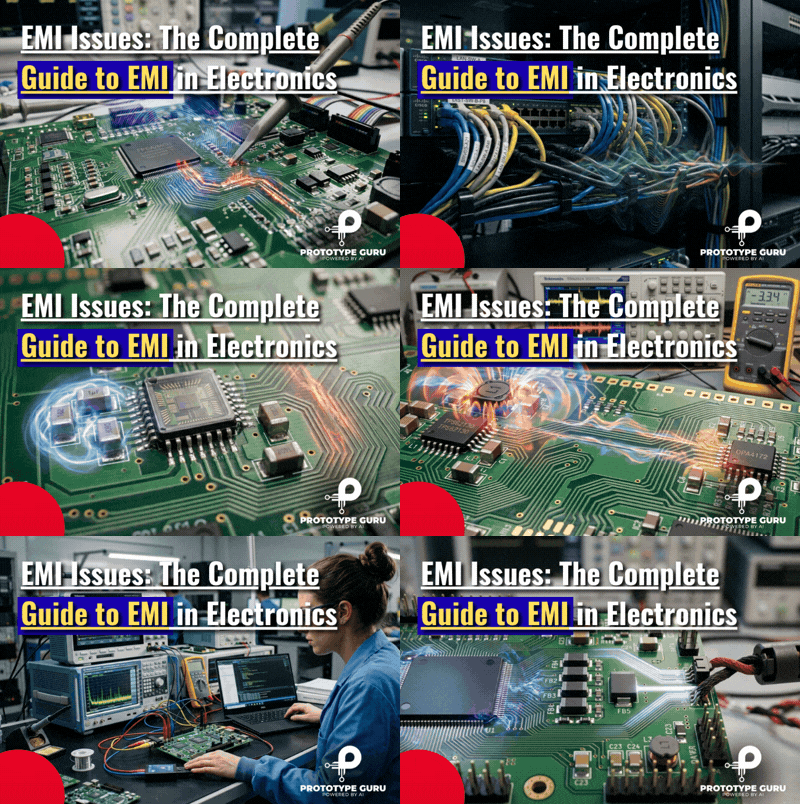
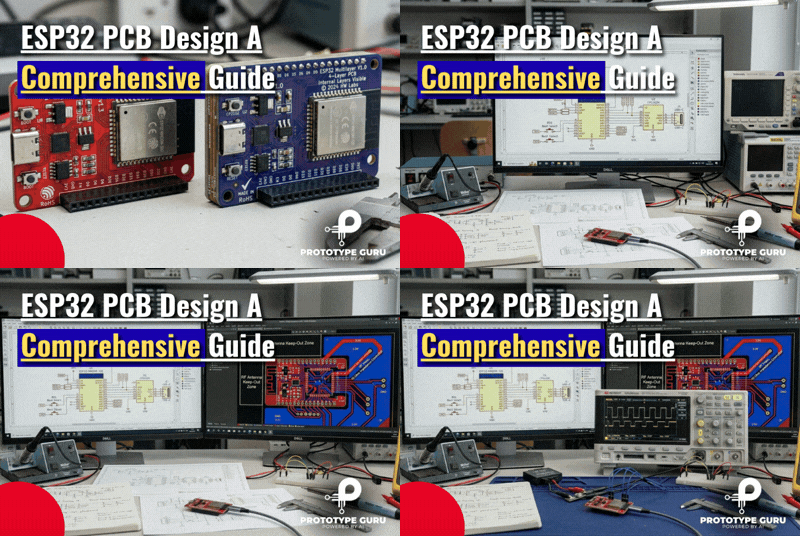
An EMI EMC filter is a passive electronic network designed to suppress high-frequency electromagnetic noise in electrical systems while allowing normal operating power to pass without distortion. In modern electronics, every switching event generates unwanted electromagnetic interference, which can travel through cables or radiate into the environment, affecting nearby circuits and sensitive devices.
The primary purpose of an EMI EMC filter is to ensure electromagnetic compatibility, meaning the system should neither generate excessive noise nor become affected by external interference. This is critical in power supplies, industrial automation, communication equipment, and high-speed digital circuits.
Without EMI filtering, electronic devices may fail regulatory compliance tests or suffer from unstable operation, signal corruption, and reduced efficiency.
How EMI EMC Filters Work
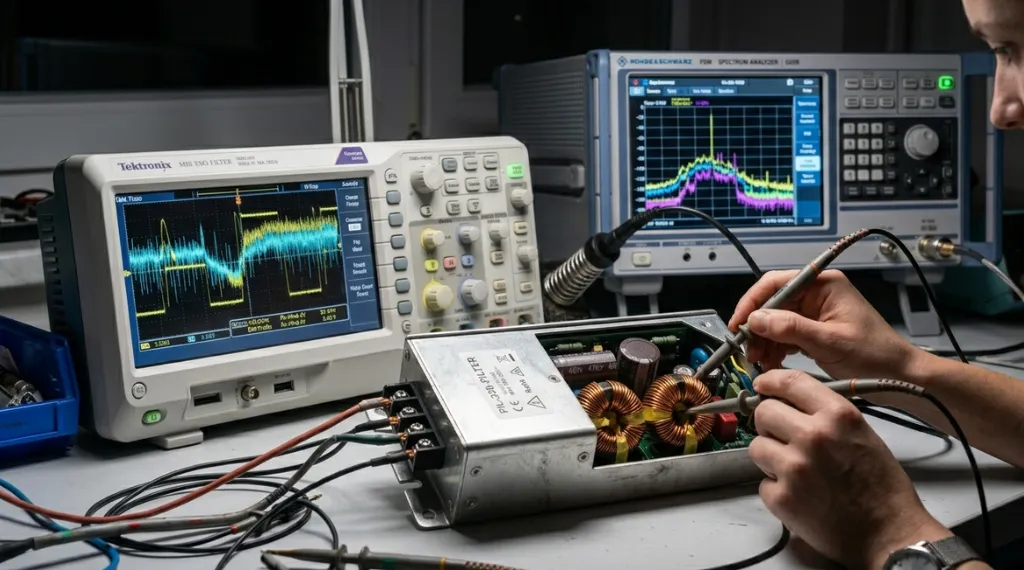
The operation of an EMI EMC filter is based on frequency-selective impedance control. It allows low-frequency power signals (50/60 Hz or DC components) to pass through while blocking or attenuating high-frequency noise generated by switching devices and fast digital transitions.
Electrical noise in a system is generally divided into conducted EMI and radiated EMI. Conducted EMI travels through physical conductors such as power lines, while radiated EMI propagates through electromagnetic fields.
Conducted EMI in Electronic Systems
↑Differential Mode and Common Mode Noise
↓Working Principle of EMI EMC Filters
↓Noise Attenuation Mechanism in EMI Filters
↓EMI Filter Circuit Components
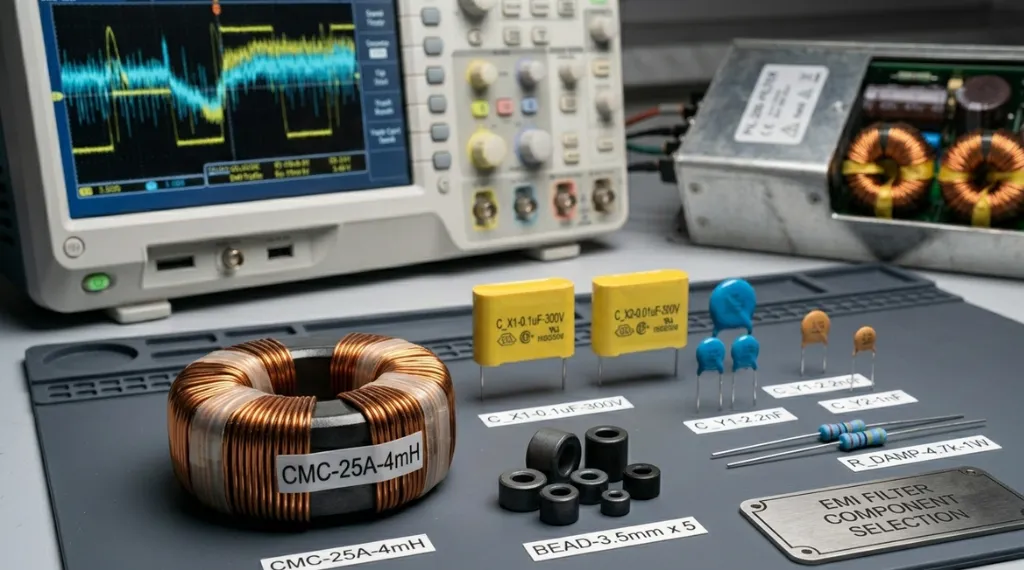
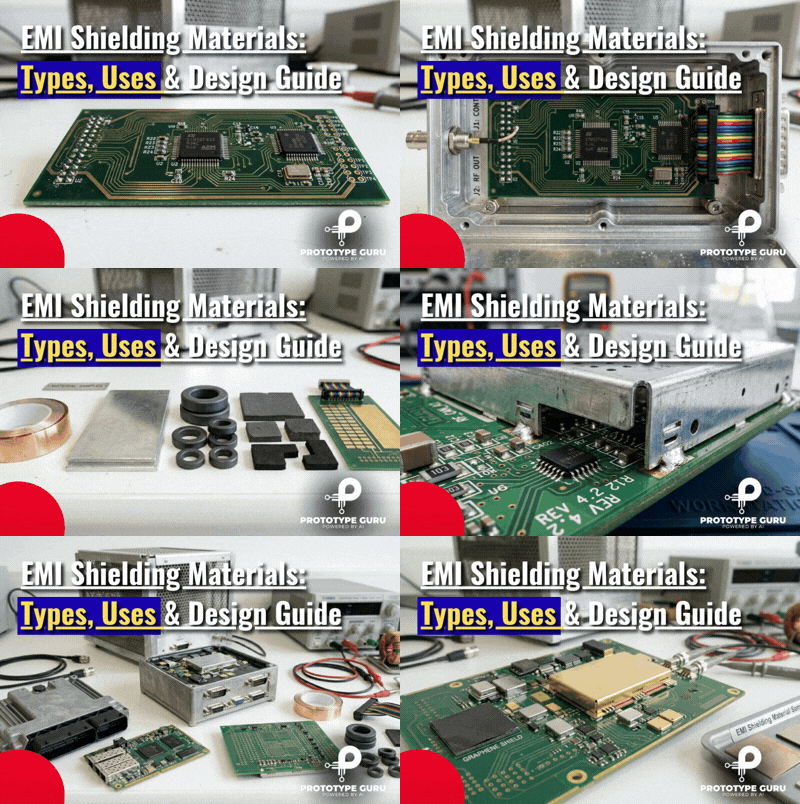
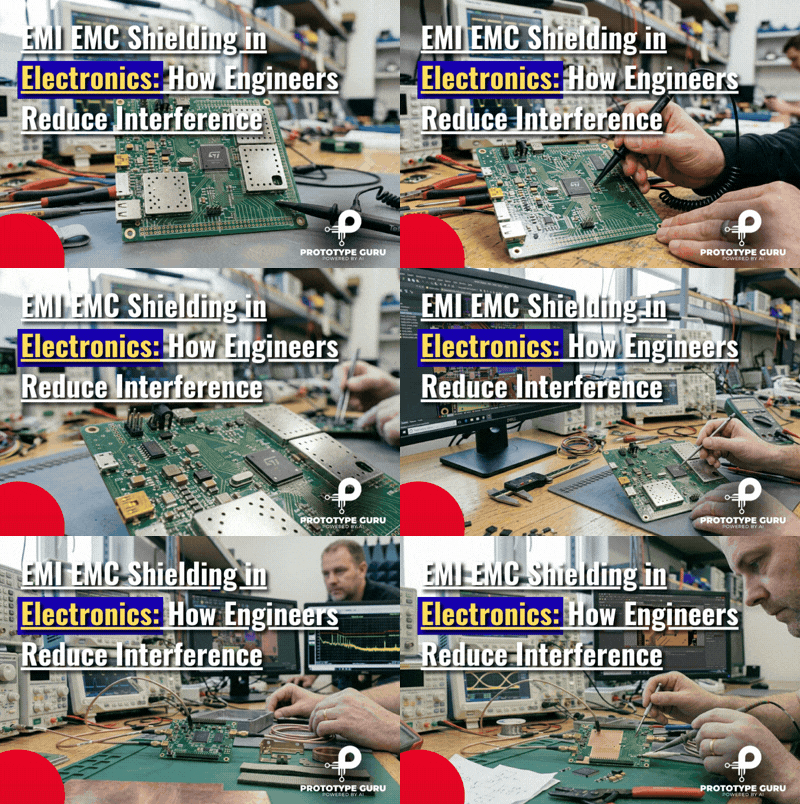
A standard EMI EMC filter is built using carefully selected passive components that target different noise modes and frequency ranges.
The common mode choke is the core element of the filter. It consists of two windings on a shared magnetic core. Under normal operation, the magnetic flux cancels out, allowing power current to pass with minimal loss. However, high-frequency common mode noise does not cancel and is strongly attenuated due to high inductance.
X capacitors are placed across line and neutral conductors. Their role is to suppress differential mode noise by providing a low-impedance path for high-frequency ripple currents. These capacitors must meet strict safety standards because they are directly connected to AC mains.
Y capacitors are connected between line/neutral and ground. They are specifically designed to suppress common mode noise by diverting it to earth. However, their values are carefully limited because they contribute to leakage current, which must remain within safety regulations.
In high-noise environments, a differential mode inductor is added in series with the line. This inductor increases impedance for switching ripple currents while allowing DC or low-frequency power to pass.
Together, these components form a coordinated filtering network that targets both noise types across a wide frequency spectrum.
How EMI EMC Filters Affect Key Components
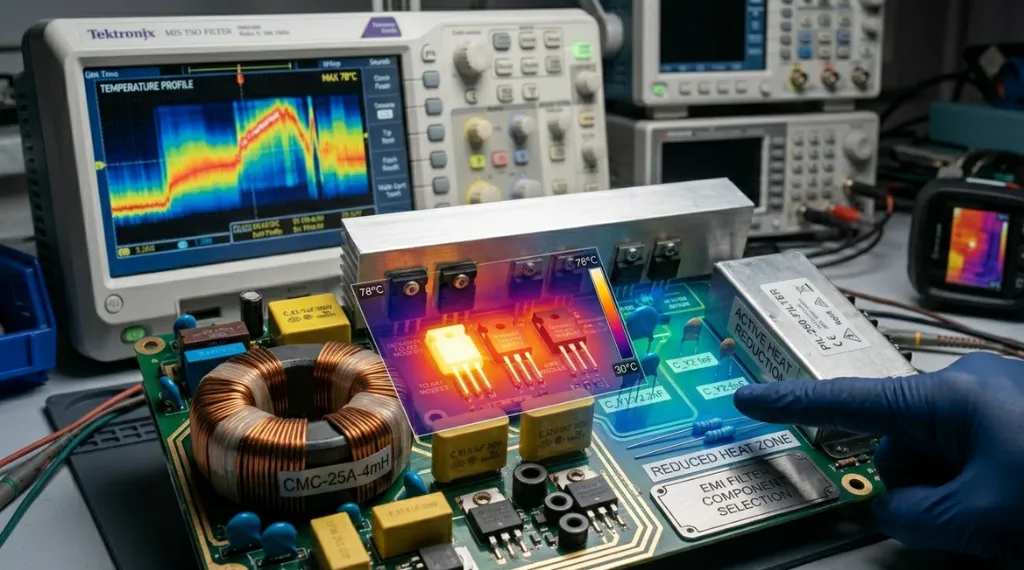
The presence of an EMI EMC filter significantly improves the electrical environment inside a system, directly impacting the performance of active and passive components.
For power semiconductor devices like MOSFETs and IGBTs, EMI filters reduce high-frequency voltage spikes caused by fast switching transitions. This minimizes electrical stress, reduces switching losses, and improves overall device reliability.
Impact of EMI Filtering on Electronic System Components
Stable Operation of Digital ICs and Processors
EMI filtering improves the quality of power supplied to control ICs and processors by removing high-frequency disturbances. This prevents logic instability, timing mismatches, and unexpected system resets in digital electronics.
Improved Voltage Rail Stability
Clean power rails are essential for accurate system performance. EMI suppression reduces noise on supply lines, ensuring stable reference voltages and improving precision in analog and digital circuits.
Higher Efficiency in Magnetic Components
Transformers and inductors operate more efficiently in low-noise environments. Reduced electromagnetic interference minimizes core losses, improves energy transfer, and decreases unwanted heat generation.
Extended Lifespan of Capacitors
EMI filtering reduces high-frequency ripple stress on capacitors, lowering thermal strain and electrical aging. This directly increases component lifespan and improves long-term system reliability.
EMI Reduction Techniques Using Passive Components
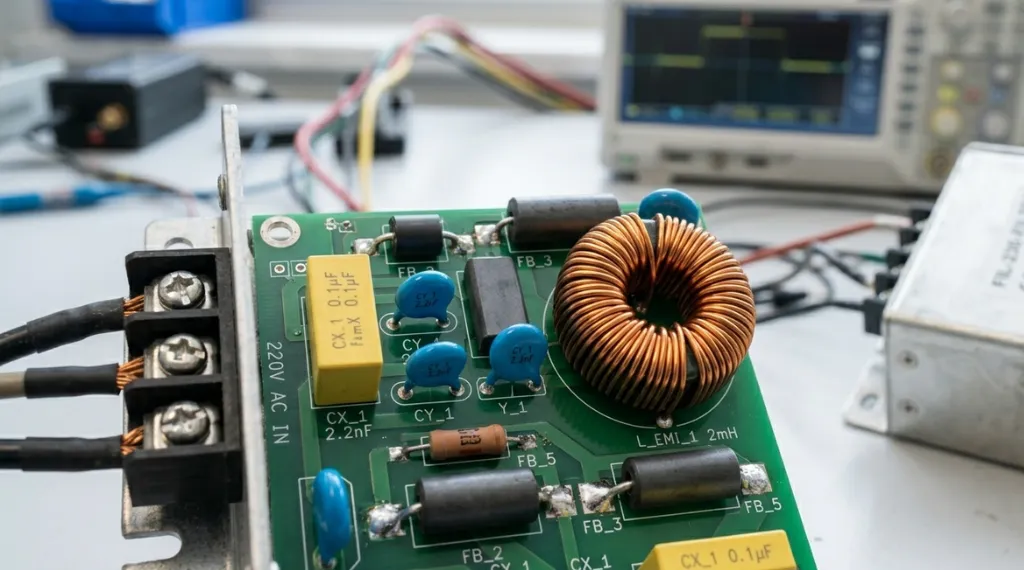
Passive EMI reduction techniques form the foundation of noise control in electronic design. These methods are widely used because they are reliable, low-cost, and highly effective when properly implemented.
Capacitors play a central role in noise suppression. Small ceramic capacitors placed near IC power pins act as local decoupling elements, reducing high-frequency noise before it spreads across the PCB. Larger X and Y capacitors are used in power input stages to suppress conducted EMI at system level.
Inductors suppress high-frequency noise while allowing normal DC current to pass, making them essential in EMI control for power and signal circuits.
Common mode chokes reduce unwanted noise on power lines without affecting useful differential current in electronic systems.
Differential inductors minimize switching converter ripple and stabilize current flow in power regulation circuits.
Ferrite beads provide high impedance at high frequencies while remaining nearly transparent at DC, ideal for signal line filtering.
Resistors in snubber circuits damp oscillations and reduce voltage ringing at switching nodes, lowering EMI in power electronics.
Effective EMI suppression combines multiple components together to achieve stable, low-noise performance in modern electronic systems.
EMI Reduction Techniques Using Active Components
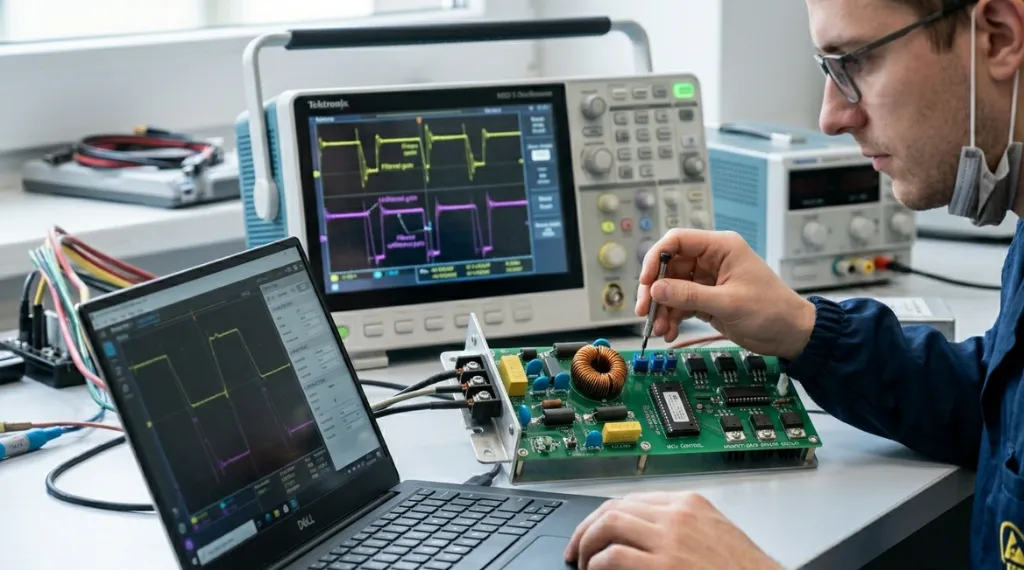
Active EMI reduction techniques involve controlling or modifying the behavior of switching devices to reduce noise at its source.
One common method is gate drive control, where the switching speed of MOSFETs or IGBTs is adjusted using gate resistors. Slower switching reduces dv/dt and di/dt, which directly reduces EMI generation, although it may slightly increase switching losses.
Another advanced technique is spread spectrum modulation, where the switching frequency is intentionally varied over a small range. This spreads electromagnetic energy across a wider bandwidth, reducing peak emission levels and improving compliance with EMI standards.
Some modern power controllers use active cancellation techniques, where generated noise is partially neutralized using feedback signals. These methods are often used in high-density power supplies and communication systems where passive filtering alone is insufficient.
EMI Radiation Standards
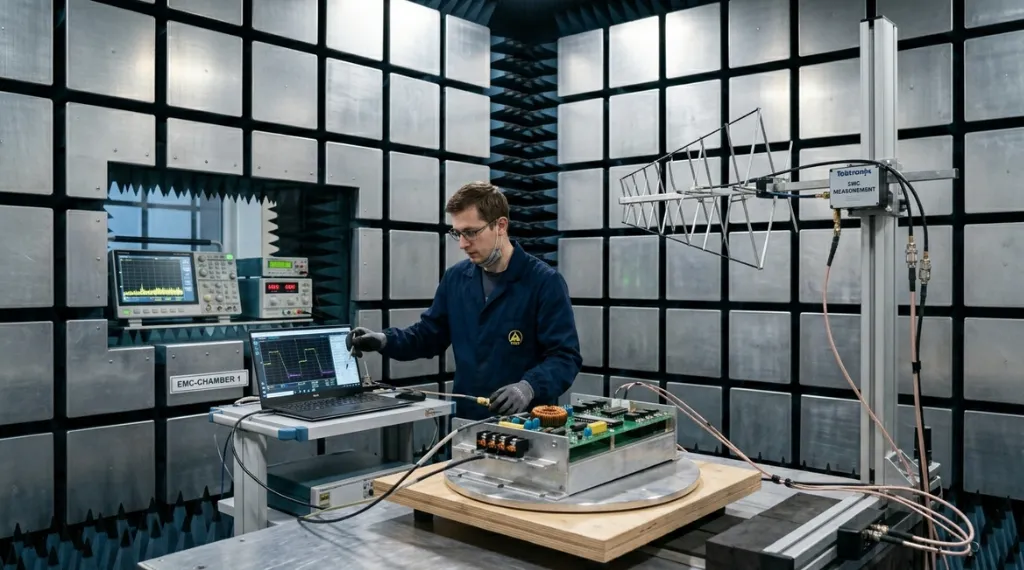
EMI and EMC standards regulate electromagnetic noise in electronic systems to ensure safe operation. They help manufacturers design compliant products that avoid interference and meet international certification requirements globally.
These standards are critical for protecting communication systems, medical equipment, and industrial machines from unwanted electromagnetic disturbances, ensuring accuracy, stability, and uninterrupted performance in complex electronic environments.
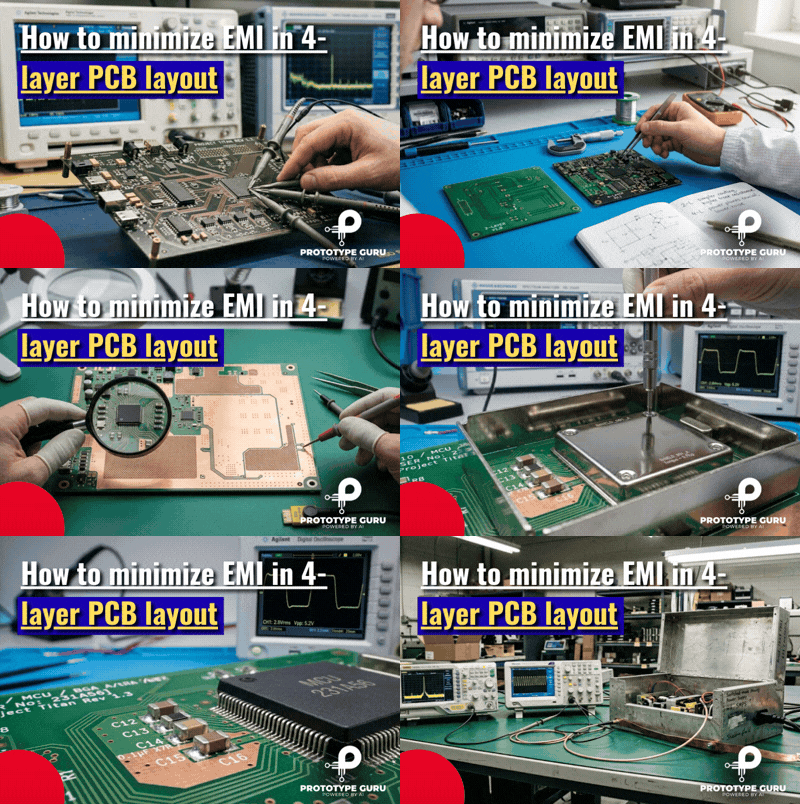
Testing includes both conducted and radiated emissions, evaluated across low and high frequency ranges. Engineers use specialized instruments and chambers to verify that devices meet strict compliance limits effectively.
EMI/EMC Compliance Breakdown
| Process Stage | Testing Focus | Tools Used | Outcome |
|---|---|---|---|
| Design Phase | Noise reduction planning | Simulation tools | Early EMI control |
| Prototype Evaluation | Pre-compliance check | Spectrum analyzer | Issue detection |
| Pre-Compliance | Emission testing | EMI receiver | Gap identification |
| Compliance Testing | Regulatory validation | EMC chamber | Certification ready |
| Market Release | Ongoing monitoring | Audit tools | Compliance maintained |
| Failure Analysis | Debug interference | Oscilloscope | Fix & redesign |
EMI Testing and Measurement
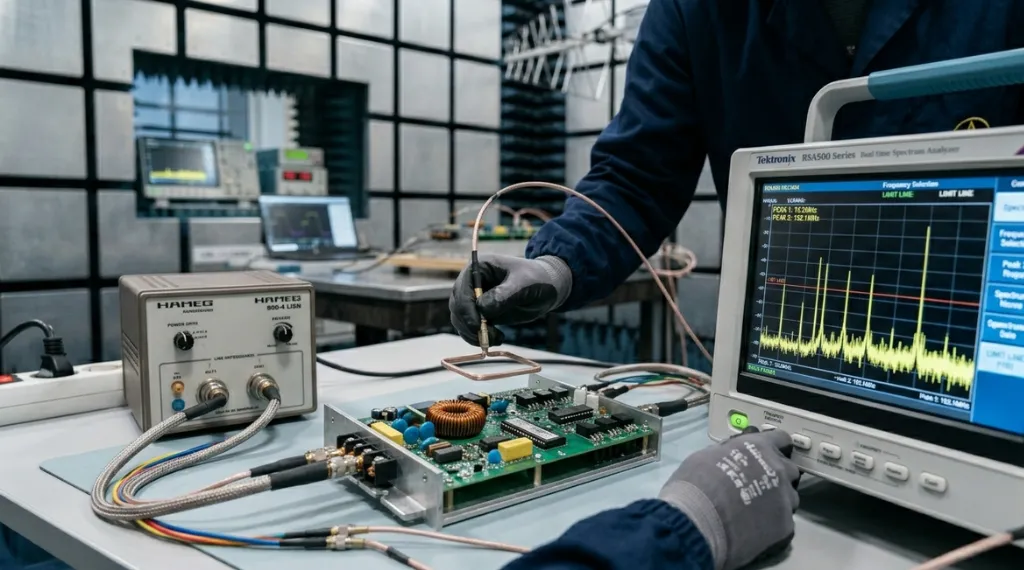
EMI testing is a critical phase in product development that ensures compliance with regulatory standards before mass production.
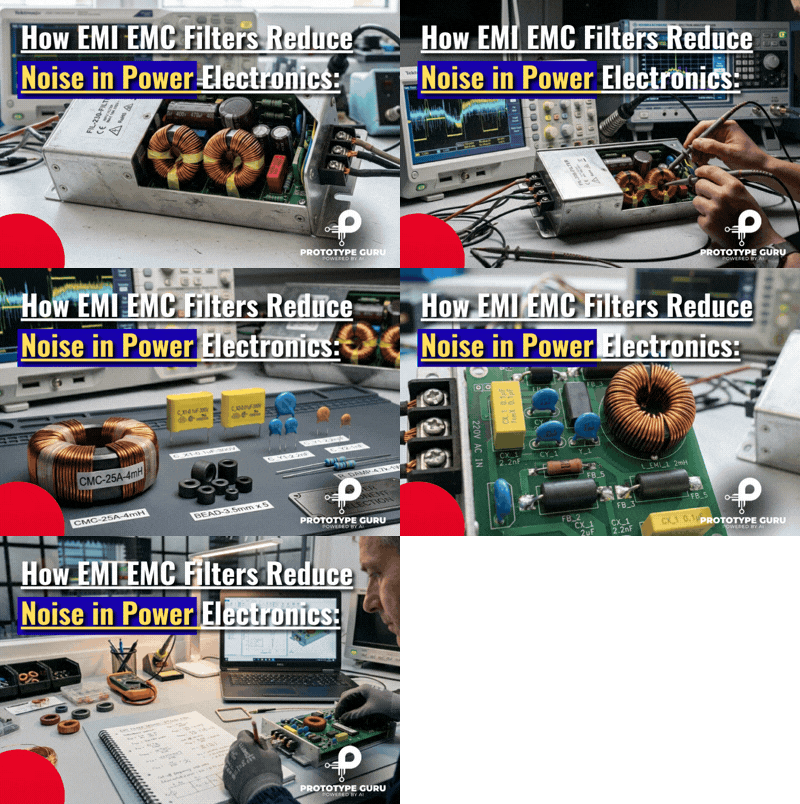
The most common setup includes a Line Impedance Stabilization Network (LISN), which provides a controlled impedance environment for measuring conducted emissions. A spectrum analyzer is then used to capture and analyze noise levels across frequency ranges.
Near-field probes are used during PCB development to locate specific noise sources. These probes help engineers identify hotspots where design modifications are needed.
Testing is typically performed in both peak and average detection modes, and results are compared against regulatory limits. Engineers often perform pre-compliance testing during development to avoid costly redesigns later.
EMI Filter Design Calculation Examples
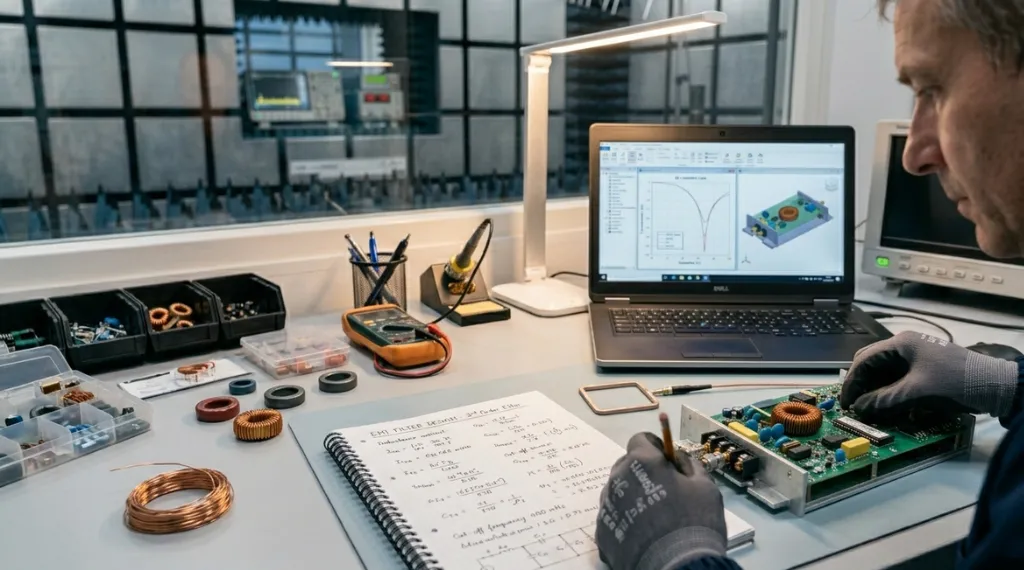
EMI filter design focuses on reducing unwanted noise while maintaining system efficiency, ensuring stable operation in electronic circuits by controlling interference across different frequency ranges and load conditions effectively.
Different applications require different filtering levels, from simple power supplies to complex industrial systems, depending on current rating, switching noise, and required electromagnetic compatibility performance standards.
Low-Power SMPS Filtering
Compact single-stage filters are used to achieve cost-effective EMI suppression in low-power switching systems.
High-Power Multi-Stage Filtering
Multi-stage filters handle wide-frequency noise and improve attenuation in high-power electronic systems.
Industrial Drive Protection
Three-phase filters control heavy current and reduce interference in long cable industrial drive systems.
Stable Operating Design
Proper filter design prevents saturation and ensures consistent EMI performance under all operating conditions.
Selecting and Buying an EMI EMC Filter Online
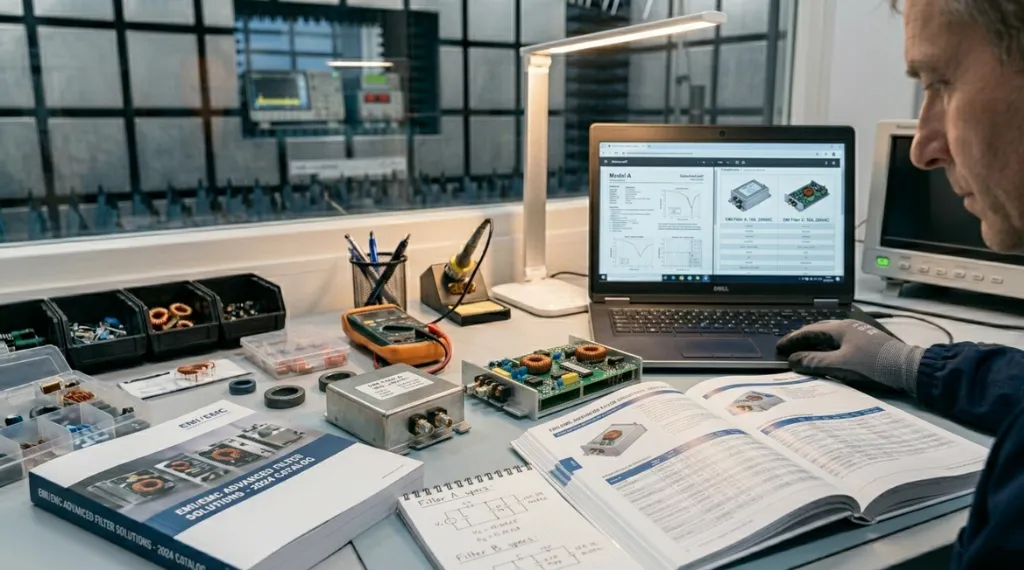
Choosing an EMI EMC filter requires evaluating electrical and environmental factors such as current rating, voltage rating, and system load to ensure reliable performance and safe long-term operation consistently stable.
Key considerations include attenuation, leakage current, and certifications. Insertion loss must be checked across frequency range, while safety standards like UL, VDE, and ENEC ensure compliance and reliability verification assurance.
EMI EMC Filter Selection Parameters
| Parameter | Specification | Purpose | Notes |
|---|---|---|---|
| Current Rating | >25% above maximum load | Safe continuous operation | Provides thermal and safety margin |
| Voltage Rating | Equal or higher than system voltage | Prevent breakdown under transients | Handles surge and spike conditions |
| Attenuation | Insertion loss performance | Reduce EMI noise across spectrum | Verify full frequency range (150 kHz–30 MHz) |
| Leakage Current | Within safety compliance limits | User and system safety assurance | Critical for medical and sensitive systems |
PrototypeGuru’s EMI EMC Filter Solutions
PrototypeGuru provides engineering-grade EMI EMC filter solutions designed for real-world power electronics applications.
Our filters are developed for different power levels, from low-power embedded systems to high-current industrial drives. Each design is optimized for attenuation performance, thermal stability, and compliance with global EMI standards.
We also provide engineering support for custom filter selection and system-level EMI troubleshooting. This helps designers reduce development time and improve first-pass success during compliance testing.
PrototypeGuru additionally offers prototype samples, enabling engineers to validate performance before moving to production.
Conclusion
EMI EMC filters are a fundamental part of modern electronics, ensuring system stability, regulatory compliance, and long-term reliability. They control electromagnetic noise at both circuit and system level, making them essential in power electronics, communication systems, and industrial applications.
A well-designed EMI filter is not just a supporting component—it is a core requirement for any professional electronic product.