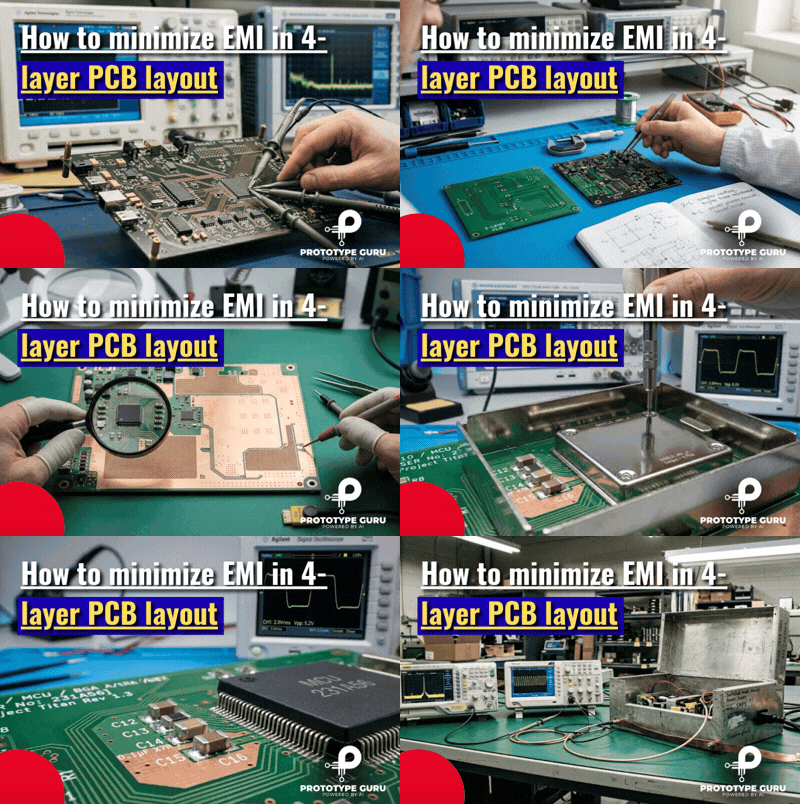










Introduction: why 4-layer PCBs control EMI better
If you want to know how to minimize EMI in 4-layer PCB layout, the answer starts with one decision: choosing the right stackup before you place a single component. Every major EMI failure in PCB design traces back to a layout decision made in the first hour of the project.
A 4-layer PCB achieves approximately 15 dB lower radiated EMI than a comparable 2-layer board. That difference is often the exact margin between passing and failing FCC Part 15 Class B limits. But this benefit only materializes when the four layers are arranged and used correctly.
At PrototypeGuru, Pakistan’s trusted prototyping company, we have built PCB prototypes across Karachi, Lahore, and Islamabad. We see the same EMI mistakes repeated across designs of every complexity level. This guide covers every technique that works, in the order you need to apply them.
Foundation: what is EMI and why does a 4-layer PCB control it better?
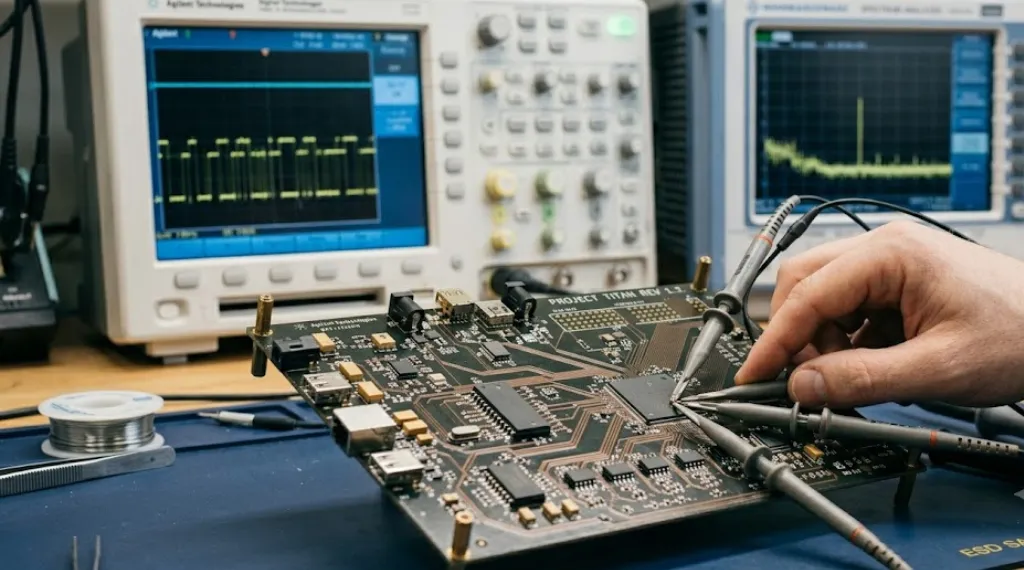
EMI stands for electromagnetic interference. It is unwanted electromagnetic energy generated by your circuit that disrupts your own board or nearby devices. EMI is generated by rapidly changing currents flowing through loops.
Every signal trace has a forward current path and a return current path. The area enclosed between these two paths is the loop area. This loop area behaves like a small antenna. The larger the loop area, the stronger the radiated emissions at high frequencies.
A 2-layer PCB has no continuous ground plane. Return currents travel through a shared ground grid with unpredictable paths and large loop areas. A 4-layer PCB places a solid ground plane on Layer 2 directly beneath the signal layer on Layer 1. Return currents flow directly beneath their signal traces, keeping loop areas minimal and dramatically reducing emissions.
Core principle
The entire strategy for minimizing EMI in a 4-layer PCB comes down to one rule: minimize loop area by keeping signal return paths short, direct, and unbroken at every point in the layout.
EMC compliance standards including FCC, CE, and CISPR all measure radiated and conducted emissions across the 30 MHz to 1 GHz range. A board that generates large loop areas will fail these tests regardless of how clean the schematic looks.
Decision guide: when should you use a 4-layer PCB for EMI control?
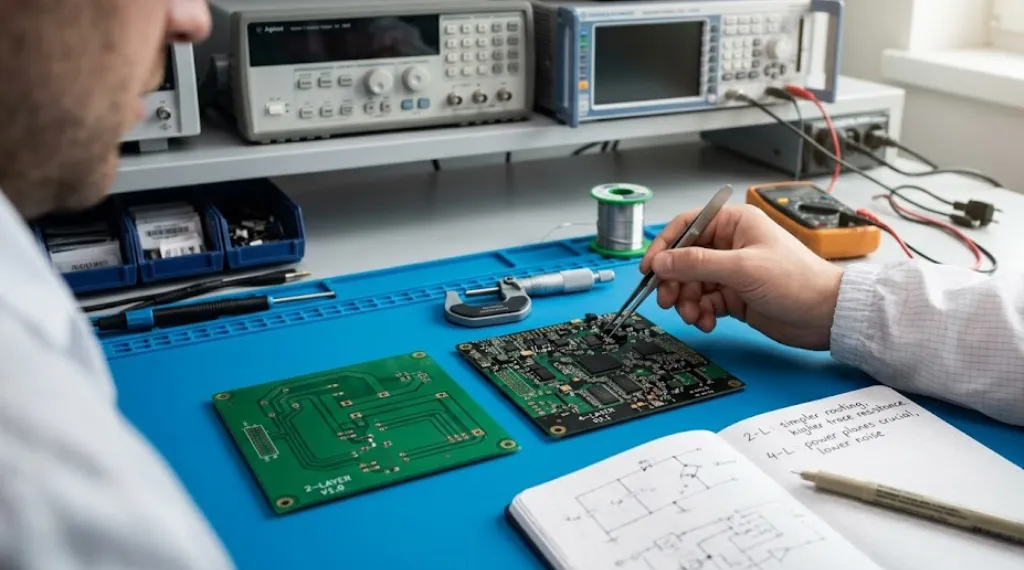
Use a 4-layer PCB when your design includes any of the following conditions. If two or more apply, a 4-layer board is not optional.
Including USB, Ethernet, HDMI, PCIe, or DDR memory on the same board.
Above 50 MHz anywhere in the circuit.
Sharing the board with sensitive analog or RF sections.
FCC, CE, or CISPR certification requirements for product market entry.
With analog measurement circuits and digital switching circuits on the same board.
That cannot be completed cleanly on two layers without long detours or excessive vias.
PrototypeGuru note
For teams looking for rapid prototyping services in Pakistan, upgrading to 4-layer prototype builds is more affordable today than at any previous point. The cost difference between a 2-layer and 4-layer prototype is almost always recovered by improved first-pass EMC success rates and reduced redesign cycles.
Step 01 How to choose the right 4-layer stackup for EMI reduction
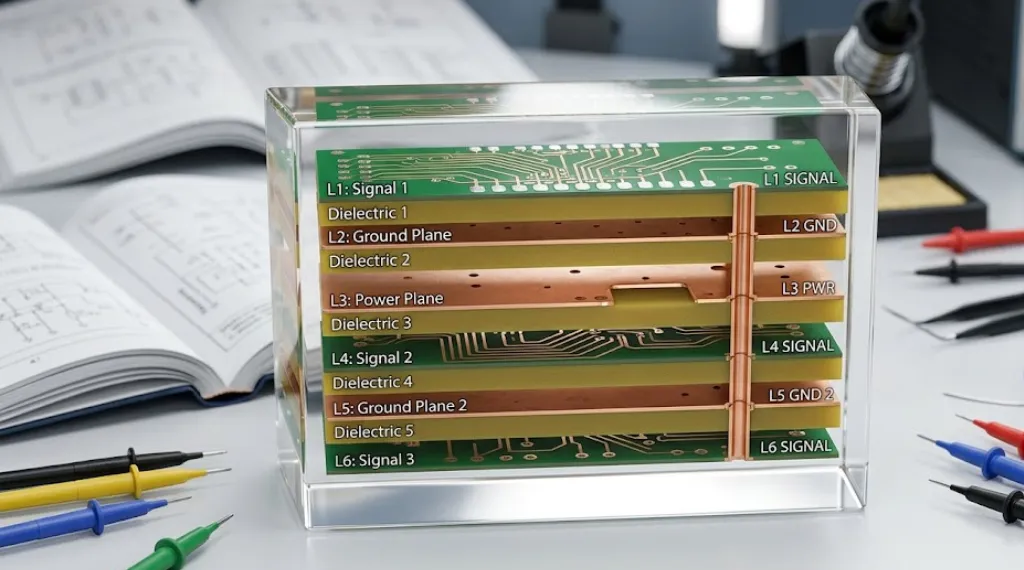
The stackup is the arrangement of your four copper layers. It must be decided before component placement begins. Changing the stackup after routing starts requires a full redesign. This is the most important single decision in minimizing EMI in a 4-layer PCB layout.
The best stackup: Signal-Ground-Power-Signal (SGPS)
The Signal-Ground-Power-Signal arrangement is the most effective and most widely used 4-layer stackup for EMI control. It works for the majority of digital, mixed-signal, and moderate-speed designs.
// RECOMMENDED SGPS STACKUP — EMI OPTIMIZED

Layer 1   SIGNAL (Top)      Component placement + critical signal routing
          ← Thin dielectric, ideally < 0.2 mm for tight coupling

Layer 2   GND               Solid, continuous — no splits or gaps
          ← Keep < 0.254 mm (10 mil) for max plane capacitance

Layer 3   POWER (VCC Plane) 1–2 nF/in² distributed capacitance with GND
          ← General routing, lower-speed signals

Layer 4   SIGNAL (Bottom)   Secondary routing, lower-speed traces
Route your fastest and most critical signals on Layer 1. The Layer 2 ground reference gives them the best return path available on a 4-layer board. The power plane on Layer 3, closely spaced to the ground plane on Layer 2, creates approximately 1 to 2 nanofarads per square inch of distributed capacitance that provides high-frequency power noise filtering without any discrete components.
Alternative stackup configurations
| Stackup | Best for | EMI rating | Trade-off |
|---|---|---|---|
| SGPS (Signal-GND-PWR-Signal) | Digital, mixed-signal, general purpose | Excellent | None for most designs |
| SGSS (Signal-GND-Signal-Signal) | High routing density, lower speed | Medium | Bottom signals lack reference plane |
| GSSG (GND-Signal-Signal-GND) | RF, sensitive analog, max shielding | Excellent | No dedicated power plane, complex routing |
Never use these stackups
Signal-Signal-Power-Ground and Signal-Power-Ground-Signal both leave the top signal layer without a nearby reference plane. High-speed signals on those layers will radiate aggressively because return currents must travel the full board thickness to find a reference, creating massive loop areas that cause guaranteed EMC failures.
Step 02 How to design a continuous ground plane that actually reduces EMI
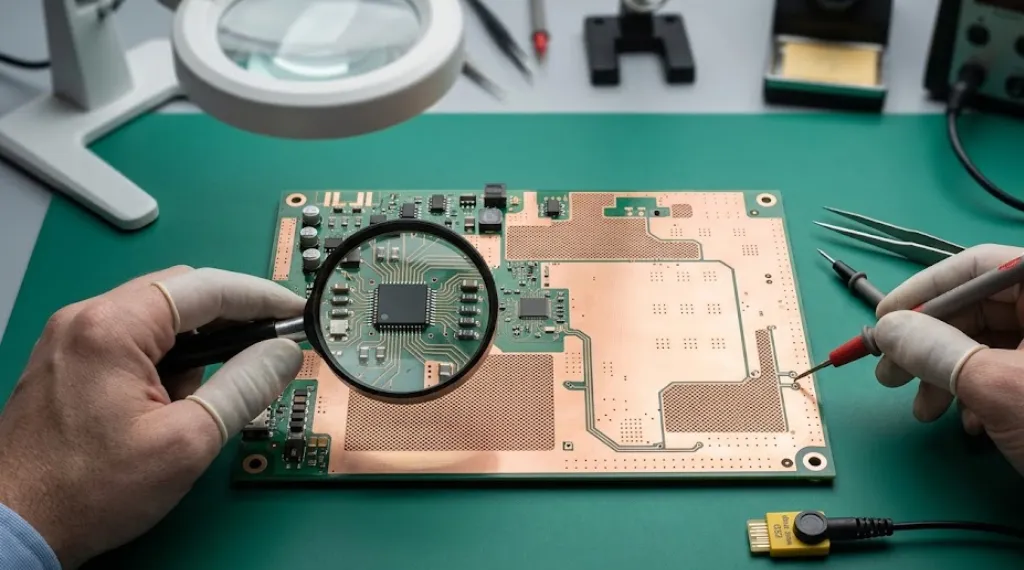
A ground plane is only effective when it is continuous and unbroken. Gaps, slots, voids, and splits in the ground plane are the leading cause of EMI compliance failures in boards that otherwise use a correct 4-layer stackup.
When a signal trace crosses a gap in the ground plane, the return current cannot flow directly beneath the trace. It spreads out to find the nearest available path, creating a large current loop that radiates at the switching frequency and all its harmonics. Research confirms that a gap as small as 1 mm in the ground plane can increase EMI radiation by 10 to 15 percent at frequencies above 100 MHz.
Ground plane rules you must follow
- Never route any high-speed, clock, or switching power supply trace over a gap or slot in the reference plane. This is the single most common cause of EMC failures across all PCB designs.
- Keep the ground plane as large and uninterrupted as possible across the entire Layer 2 area. Avoid placing component pads or thermal relief patterns that cut across the plane beneath critical signals.
- If you must split the ground plane to separate analog and digital regions, bridge signal crossings with stitching capacitors or route those signals on a layer that has an unbroken reference.
- Never route any signal on the ground plane layer to solve a routing problem. Even a short stub trace on Layer 2 creates a path discontinuity that disrupts nearby return currents.
Via stitching for ground continuity
Via stitching means placing multiple ground vias at regular intervals to connect ground copper on outer layers directly to the inner ground plane.
- Place stitching vias every 5 to 10 mm along the edges of ground copper pours and near high-speed signal areas.
- In RF zones or shielded areas, space vias approximately one-tenth of the signal wavelength at the highest operating frequency.
- Connect every copper pour on Layer 1 and Layer 4 to the Layer 2 ground plane through multiple stitching vias. A floating copper pour not properly stitched to ground acts as a receiving and re-radiating antenna.
Step 03 How should you place components to minimize EMI in a 4-layer PCB?

Component placement controls how much of your stackup benefit you actually use. Poor placement forces long signal traces, increases loop areas, and undoes everything the ground plane provides. Placement must be decided before routing begins.
Separate functional blocks physically
Divide the board into clear zones before placing any component. This separation prevents digital switching noise from coupling into sensitive analog circuits through shared ground or power planes.
| Zone | Components | Placement rule |
|---|---|---|
| Power supply | Switching regulators, inductors, MOSFETs, bulk capacitors | Near board corner, away from analog and RF sections |
| High-speed digital | MCU, FPGA, clock sources, DDR memory | Grouped together with short interconnects |
| Analog | Amplifiers, ADCs, DACs, sensors | Maximum distance from digital switching circuits |
| Input/output | Connectors, interface ICs | Near board edge with filters placed immediately at entry |
20H separation rule
Maintain a minimum separation of 20H between analog and digital zones, where H is the dielectric thickness between Layer 1 and Layer 2. For standard FR4 with 0.2 mm dielectric, this means at least 4 mm between analog and digital component boundaries.
Keep noisy components away from board edges
Board edges are one of the strongest EMI radiation points in any PCB layout. Traces near the edge have no surrounding copper to contain the electromagnetic field. Place switching power supply components, clock oscillators, and high-frequency digital circuits well away from board edges. Maintain a clearance of at least one dielectric thickness from the nearest trace to the board edge as a minimum rule.
Step 04 What are the best routing techniques to minimize EMI in a 4-layer PCB?
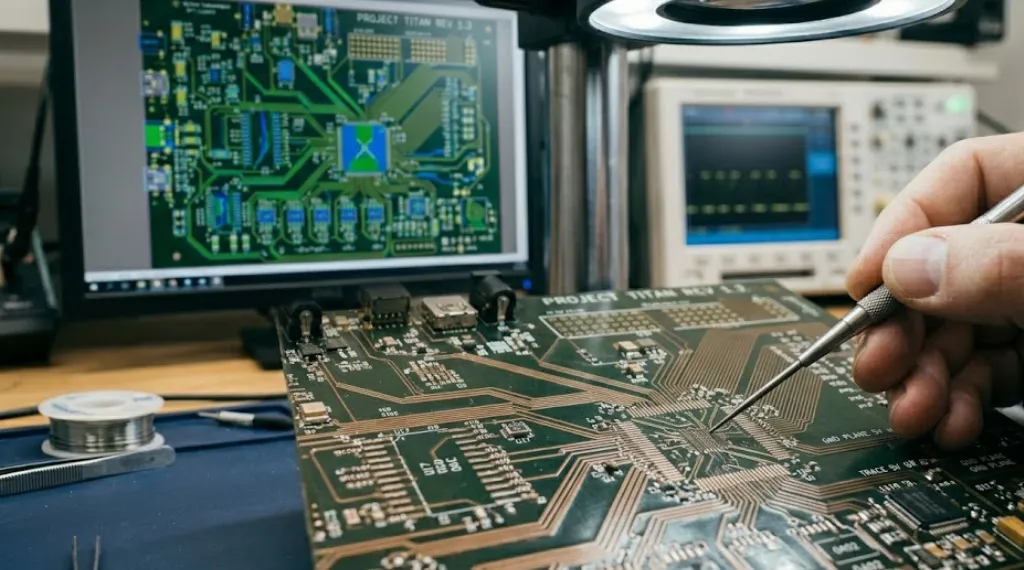
Routing technique directly determines how much EMI your board generates. A correct stackup and excellent placement can still produce an EMC failure if routing rules are not followed consistently across every high-speed net.
Always place a ground via next to every signal via
When a signal changes layers through a via, its return current must also change reference layers. Without a ground stitching via placed immediately adjacent to the signal via, within 2 mm, the return current spreads out searching for a new reference path. This detour creates a large current loop that becomes a radiation hotspot detectable during near-field probing.
Most overlooked rule
Place a ground stitching via next to every signal via that transitions between layers. This single rule, consistently applied, can eliminate entire categories of EMI problems that only appear at pre-compliance testing.
Control trace impedance for every high-speed net
Impedance mismatches in high-speed traces cause reflections. Reflected signals generate additional high-frequency noise that contributes directly to radiated emissions across the EMC test frequency range.
Single-Ended Impedance
Target 50 ohm impedance for standard single-ended high-speed signals including SPI, I2C at high speed, and clock lines.
Differential Impedance
Target 90 to 100 ohm differential impedance for USB, HDMI, Ethernet, PCIe, and LVDS differential pairs.
Trace Geometry Calculation
Calculate trace width and spacing using your specific stackup dielectric thickness and material data provided by your PCB manufacturer.
Tool and Manufacturer Verification
Use your PCB design tool’s built-in impedance calculator and confirm results with the manufacturer’s stackup parameters before finalizing trace widths.
Use 45-degree bends, not 90-degree corners
Sharp 90-degree corners in signal traces create a local increase in trace width at the bend, producing an impedance discontinuity that generates reflections and contributes to EMI above 100 MHz. Use 45-degree angled bends or curved bends for all high-speed signal traces throughout the entire layout.
Apply the 3W rule to prevent crosstalk and EMI
Crosstalk is electromagnetic coupling between adjacent traces and contributes to both signal integrity failures and radiated EMI. The 3W rule states that the edge-to-edge spacing between parallel traces should be at least three times the trace width.
- For 5-mil-wide traces, maintain at least 15 mils of spacing between adjacent parallel traces.
- Apply 3W spacing for the full length of any parallel routing between high-speed signals, not just at critical sections.
- Route signals on adjacent layers using perpendicular routing directions to minimize inter-layer capacitive coupling.
- Never run two high-speed signals in parallel for more than 10 mm without adequate spacing between them.
Step 05 How do decoupling capacitors reduce EMI in a 4-layer PCB?
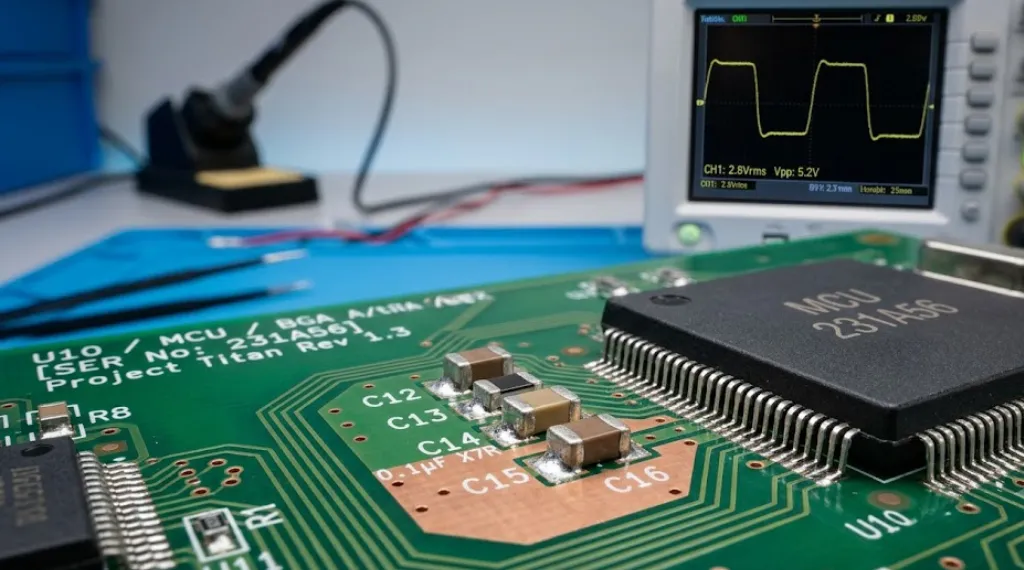
Decoupling capacitors supply the instantaneous current that ICs demand during switching transitions. Without adequate local decoupling, the IC draws current from a large area through the power distribution network, creating large current loops and high-frequency noise that radiates directly as EMI.
The law of decoupling placement is absolute: every millimeter of trace between the capacitor and the IC power pin adds approximately 1 nanohenry of parasitic inductance. At 100 MHz, just 10 nH of inductance makes a decoupling capacitor nearly ineffective for EMI suppression.
Decoupling placement rules
- Place 0.1 µF ceramic capacitors within 2 mm of every IC power pin. This is a maximum distance, not a target. Closer is always better.
- Place the connecting vias immediately adjacent to the capacitor pads, not at the end of a trace. The via connects directly into the power and ground planes.
- Prioritize decoupling capacitor placement before routing any other traces. They are the second most critical components on the board after the ICs they serve.
- Use via-in-pad construction when available to eliminate all trace inductance between the capacitor pad and the power plane connection.
Use multiple capacitor values for broadband filtering
A single capacitor value filters only a narrow frequency range. Use the combination below for every IC to achieve broadband EMI suppression across the full compliance testing range.
| Capacitor value | Function | Effective range | Placement priority |
|---|---|---|---|
| 0.1 µF ceramic | High-frequency decoupling | 10 MHz to 200 MHz | Critical — within 2 mm |
| 10 µF bulk ceramic | Mid-frequency stabilization | 1 MHz to 50 MHz | Near regulator or IC |
| 1 nF ceramic | Extended high-frequency | 100 MHz to 500 MHz | Mixed-signal ICs only |
Step 06 How do you apply shielding on a 4-layer PCB?
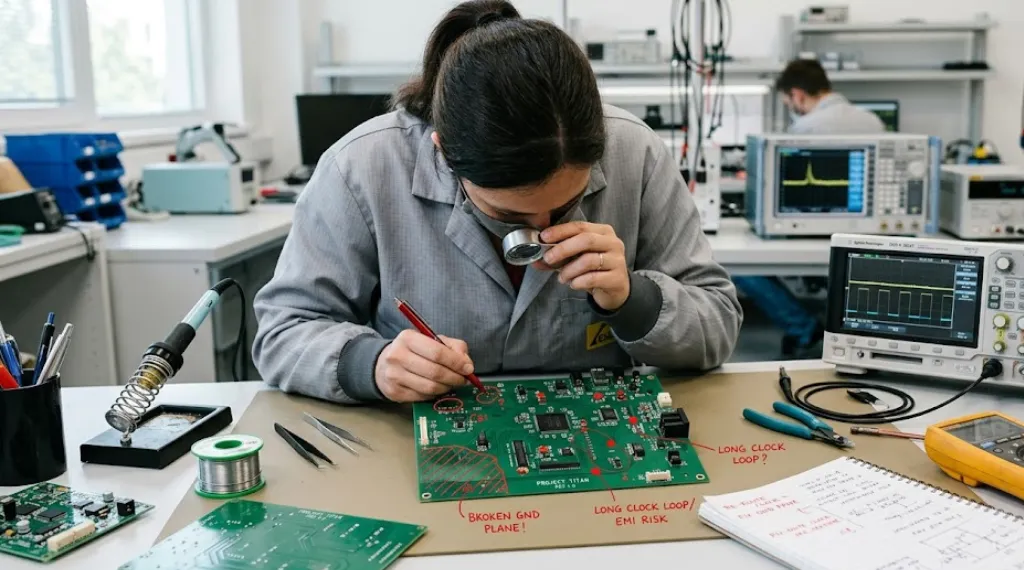
Layout techniques control most EMI in a well-designed 4-layer board. Shielding handles the remaining emissions that layout and decoupling alone cannot fully contain. Apply shielding to components that generate strong noise or require strong isolation from external interference.
Copper pour shielding
Connect all outer-layer copper pours to the ground plane through dense via stitching. A copper pour is only a shield when it is properly connected. A copper pour with sparse or no via stitching acts as an antenna rather than a shield and makes EMI worse, not better.PCB-mounted metal shield cans
For RF modules, clock oscillators, and switching power supply sections, PCB-mounted metal shield cans provide physical Faraday cage isolation. Metal cans connected to the ground plane can attenuate radiated EMI by up to 30 dB. Connect the shield perimeter to ground through the PCB footprint at multiple points, not at a single point.Ferrite beads on power lines
Ferrite beads act as high-frequency resistors on power supply traces. They absorb switching noise rather than allowing it to propagate through the power distribution network from noisy circuits to sensitive circuits. Place ferrite beads on the power supply lines feeding analog sections, RF circuits, and other noise-sensitive loads.I/O interface filtering
Every connector and I/O interface is a potential entry and exit point for EMI. Place EMI filter components including common-mode chokes, series resistors, and ESD protection devices immediately at the connector footprint before any other traces on that net. Cables connected to unfiltered I/O interfaces act as efficient antennas that radiate internally generated noise and import external interference directly into the board.
Step 07 What are the most common EMI mistakes in 4-layer PCB design?
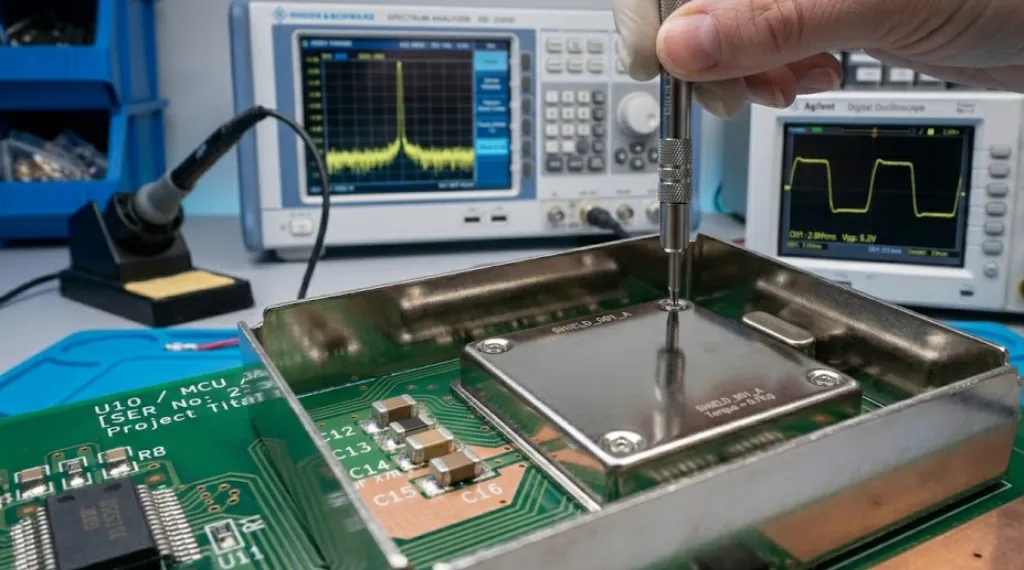
These six mistakes account for the majority of EMC test failures in otherwise well-designed 4-layer boards. Check your layout against every one of these before submitting for fabrication.
Mistake 01: Routing over a ground plane gap
The most common EMI violation. Check every high-speed trace, clock signal, and power switching node. Confirm there is no gap or slot in the ground plane beneath it at any point along the route.
Mistake 02: Decoupling caps more than 5 mm away
Any decoupling capacitor placed further than 5 mm from its IC power pin is largely ineffective for high-frequency EMI suppression. Review placement distances in your layout before routing.
Mistake 03: Missing return path at layer transitions
Skipping the ground stitching via next to signal vias is responsible for a large percentage of unexpected EMI failures discovered during pre-compliance testing. Add it to every layer transition.
Mistake 04: Leaving pins and traces floating
Floating conductors on a PCB act as small antennas. Tie unused digital IC inputs to ground or VCC through pull resistors. Connect test point pads to ground. Never leave a trace stub unconnected on a high-speed net.
Mistake 05: Unmanaged ground plane splits
Splitting the ground plane without bridging capacitors at trace crossings breaks return paths at the boundary. If high-speed signals must cross the split, bridge with stitching capacitors or route on a different layer with an unbroken reference.
Mistake 06: Wrong stackup for the application
Using a Signal-Signal-Power-Ground or Signal-Power-Ground-Signal arrangement leaves the top signal layer without a nearby reference. This single mistake makes every other EMI technique in this guide less effective.
Step 08 How do you test a 4-layer PCB for EMI before formal certification?
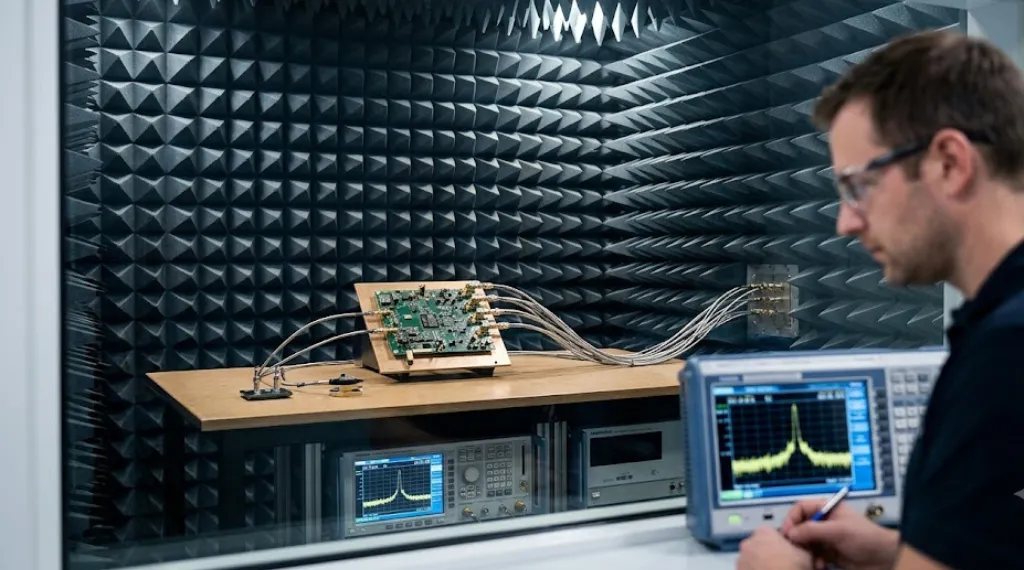
Pre-compliance testing allows you to find and fix EMI problems before committing to formal certification testing. Catching a problem at pre-compliance costs a routing change. Catching it at formal certification costs a full redesign cycle and retest fees.
Near-field probing method
Conduct near-field probing with a spectrum analyzer and near-field probe set over different areas of the powered board. Systematic probing of the power supply section, clock distribution network, and high-speed interface traces identifies the strongest radiation sources by physical location. Once you locate a hotspot, apply targeted fixes including additional decoupling, adjusted routing, increased via stitching density, or added shielding.
Documentation and records
Keep detailed records of all pre-compliance measurements and every design change made in response to them. These records support the formal certification process and reduce time spent on subsequent product revisions. Document the exact board revision, test setup, and measurement results for every test session.
Related: Electromagnetic Compatibility Testing — complete guide to pre-compliance and formal certification for FCC, CE, and CISPR standards.Related: Hardware Development Guide 2026 — how EMC testing fits into the complete product development timeline from concept to production.
PrototypeGuru: Pakistan’s trusted prototyping company
PrototypeGuru provides product design and prototyping services across Karachi, Lahore, and Islamabad. Every 4-layer PCB design we produce goes through stackup review, ground plane audit, decoupling placement verification, and routing rule checks before any prototype is built.
Frequently asked questions about minimizing EMI in 4-layer PCB layout
What is the best stackup for a 4-layer PCB to minimize EMI?
↑Signal – Ground – Power – Signal.
Placing a solid ground plane directly under the top signal layer ensures extremely short return paths, minimizing loop area and radiated emissions. This configuration also creates natural plane capacitance between power and ground (typically 1–2 nF per square inch), which helps suppress high-frequency noise. It is widely used in digital, RF, and mixed-signal designs because it offers the best balance between performance and simplicity.
How does a 4-layer PCB reduce EMI compared to a 2-layer board?
↓Compared to a 2-layer board, a properly designed 4-layer PCB can reduce radiated EMI by up to ~15 dB in equivalent designs. The key advantage is the controlled return path directly beneath signal traces, which drastically reduces loop area.
This improvement is especially important in the 30 MHz to 1 GHz range, where most EMC compliance failures occur in digital electronics.
Where should decoupling capacitors be placed on a 4-layer PCB?
↓Best practice:
• Place 0.1 µF ceramic capacitors within 2 mm of power pins
• Keep vias adjacent to capacitor pads
• Connect directly to power and ground planes
Even a small increase in trace length adds parasitic inductance (~1 nH per mm), which significantly reduces capacitor effectiveness above 50 MHz, increasing EMI and noise coupling.
Why is ground plane continuity critical for EMI reduction?
↓Any gap or split in the ground plane forces return currents to detour, increasing loop area and radiated EMI.
Even a small discontinuity (around 1 mm gap) can significantly increase emissions above 100 MHz. This is one of the most common reasons for EMC test failures in high-speed PCB designs.
How should high-speed signals be routed on a 4-layer PCB?
↓Key routing rules:
• Use 45-degree bends instead of sharp corners
• Maintain controlled impedance (50Ω single-ended, 90–100Ω differential)
• Follow 3W spacing rule between parallel traces
• Place ground stitching vias near signal vias
This ensures controlled return currents and minimizes EMI generation.
Does a 4-layer PCB reduce EMI better than a 2-layer PCB for all frequencies?
↓The biggest improvement occurs above 50 MHz, where return path inductance dominates EMI behavior. In the FCC/CE test range (30 MHz to 1 GHz), the reduction in loop area leads to significantly lower radiated emissions.
However, below ~1 MHz, power supply conducted noise becomes more dominant than layout-related radiation effects.
Conclusion: minimize EMI from the first hour of design
Knowing how to minimize EMI in 4-layer PCB layout means treating EMI as a system of interconnected design decisions, not a single technique applied at the end of the routing phase.
A correct stackup places ground directly beneath your primary signal layer. A continuous ground plane preserves the return path that stackup provides. Component placement minimizes trace lengths and loop areas. Routing with controlled impedance, 3W spacing, and ground stitching vias at every layer transition keeps high-frequency signals contained. Decoupling capacitors placed within 2 mm of every IC power pin prevent power distribution noise from becoming radiated EMI. Shielding and filtering at board boundaries handle the noise that layout techniques alone cannot fully contain.
Engineers who pass EMC compliance testing on the first attempt treat EMI as a requirement from the first hour of design, not a problem to fix after the board comes back from fabrication. Apply these techniques consistently and your 4-layer PCB prototypes will perform as designed from day one.
If you are looking for a prototyping company in Pakistan that applies these engineering principles to every build, PrototypeGuru provides PCB prototyping across Karachi, Lahore, and Islamabad with full hardware design support. Contact PrototypeGuru to discuss your product design and prototyping requirements.